
Why Most Leadership Books Focus on Control Instead of Connection
When people search for the best leadership books, they often find titles focused on influence, productivity, authority, or performance. While these topics matter, many leadership books still overlook one of the biggest realities of leadership: leadership succeeds or fails in the space between people. Research on psychological safety suggests that relational conditions strongly shape whether people speak up, learn, collaborate, and stay engaged at work (Edmondson, 1999; Edmondson & Lei, 2014).
This is one reason why relational leadership is becoming a growing focus in leadership psychology, organisational development, and workplace culture conversations. Modern organisations are dealing with burnout, communication breakdowns, mistrust, change fatigue, and increasingly complex human dynamics. Leaders are not simply managing tasks anymore. They are navigating relationships, tension, identity, trust, and collaboration. Gallup (2024) reported that only 23% of employees globally were engaged at work, reinforcing the idea that leadership challenges are often also connection and meaning challenges rather than purely performance problems.
That is where Leadership in Tune offers a different perspective.
Unlike many traditional leadership books, Leadership in Tune introduces the Conscious Relational Impact (CRI) Model™, a framework grounded in conscious alignment rather than control. The book reframes leadership as attunement: the ability to notice what is happening between people and respond with intention rather than reflex. This emphasis aligns with relational leadership theory, which positions leadership as something that emerges through interaction and relationships rather than individual authority alone (Uhl-Bien, 2006).
For leaders searching for leadership books on communication, leadership psychology books, or leadership books for managers, this shift matters. Teams rarely struggle because people lack technical knowledge alone. More often, difficulties emerge through misunderstandings, unresolved tension, emotional disconnection, poor communication, or competing expectations. Psychological safety research shows that when people feel safe in relationships with leaders, they are more likely to learn, contribute, and raise concerns rather than withdraw or stay silent (Edmondson, 1999; Edmondson & Lei, 2014).
This is why many of the best leadership books in 2025 are moving towards more human-centred leadership approaches. Leaders are increasingly recognising that sustainable performance depends on trust, relational awareness, and meaningful connection. Research on complexity leadership also highlights that modern organisations require leaders who can navigate dynamic human systems, uncertainty, and collaboration rather than relying only on hierarchy or control (Uhl-Bien et al., 2007).
Leadership in Tune combines more than thirty years of leadership experience with practical insights into organisational transformation, culture, and human systems. Rather than offering leadership “hacks”, the book explores how relational impact shapes leadership effectiveness in real organisational life. This aligns with research suggesting that engagement is not simply an individual trait but something shaped by the emotional and relational conditions created around people at work (Kahn, 1990).
For anyone looking for leadership books recommended for modern workplaces, Leadership in Tune offers a practical and reflective alternative to command-and-control leadership thinking.
If you are exploring the best leadership books for communication, trust, collaboration, and human-centred leadership, Leadership in Tune is available for pre-order now.
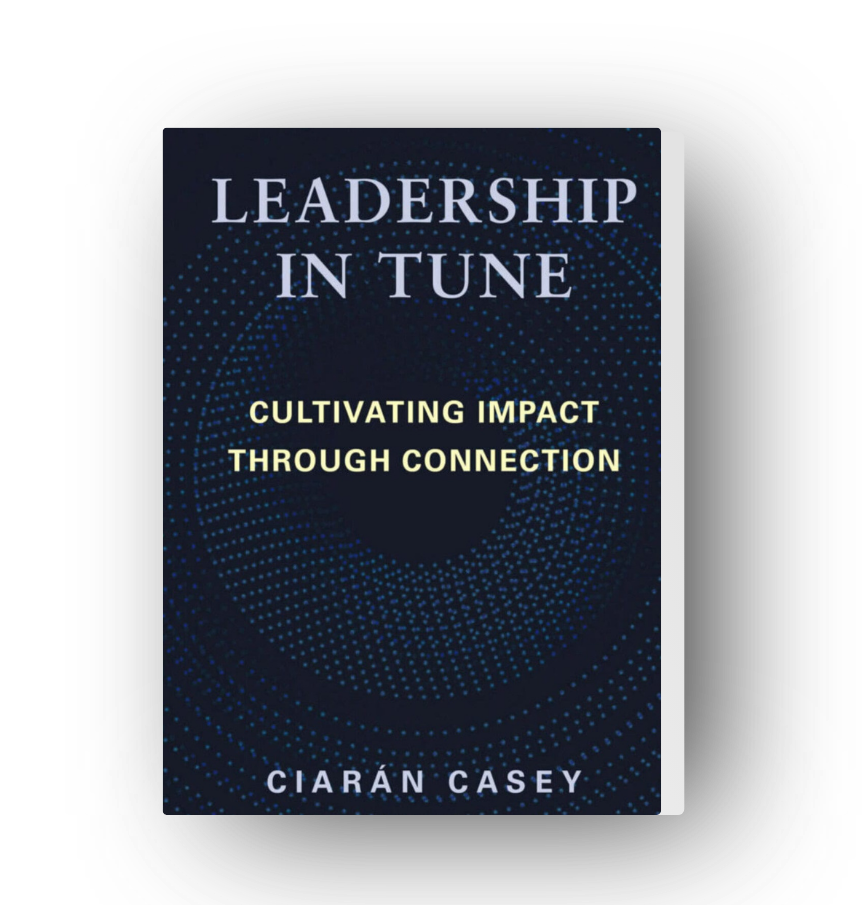
Leadership In Tune:
Cultivating Impact Through Connection
Blending real leadership stories, relational insight, and a practical 90-day integration plan, the book offers a reflective and grounded approach to leadership. Drawing on more than thirty years of experience, Ciarán Casey explores how connection, trust, and human dynamics shape leadership in practice.
References
Edmondson, A. C. (1999). Psychological safety and learning behavior in work teams. Administrative Science Quarterly, 44(2), 350–383.
Edmondson, A. C., & Lei, Z. (2014). Psychological safety: The history, renaissance, and future of an interpersonal construct. Annual Review of Organizational Psychology and Organizational Behavior, 1, 23–43.
Gallup. (2024). State of the global workplace 2024. Gallup.
Kahn, W. A. (1990). Psychological conditions of personal engagement and disengagement at work. Academy of Management Journal, 33(4), 692–724.
Uhl-Bien, M. (2006). Relational leadership theory: Exploring the social processes of leadership and organizing. The Leadership Quarterly, 17(6), 654–676.
Uhl-Bien, M., Marion, R., & McKelvey, B. (2007). Complexity leadership theory: Shifting leadership from the industrial age to the knowledge era. The Leadership Quarterly, 18(4), 298–318.