
Best Leadership Books for Managers in 2025 & 2026: The Rise of Relational Leadership
Many leadership books for managers focus on strategy, delegation, productivity, or motivation. While these skills remain important, modern leadership increasingly requires something deeper: the ability to lead relationships, not just processes. Gallup workplace research continues to show that managers account for a significant share of variation in employee engagement, reinforcing how leadership impact often happens relationally through day-to-day interactions (Gallup, 2024).
As organisations navigate hybrid working, burnout, rapid change, and increasing complexity, relational leadership is becoming one of the most important leadership capabilities in 2025. Leaders are now expected to navigate communication, trust, emotional tension, collaboration, and culture alongside operational performance. In increasingly complex workplaces, leadership challenges are rarely technical alone. They are often relational, emotional, and systemic, requiring leaders to navigate trust, communication, and uncertainty simultaneously (Uhl-Bien et al., 2007).
This changing reality is why relational leadership books are gaining attention.
Leadership in Tune introduces the Conscious Relational Impact (CRI) Model™, a practical framework built around the idea that leadership succeeds or fails in the space between people. Research on employee engagement and psychological safety suggests that people are more likely to contribute, collaborate, and remain engaged when relationships with leaders feel supportive, safe, and meaningful (Edmondson, 1999; Kahn, 1990).
Rather than positioning leadership as control or authority, Leadership in Tune explores leadership as attunement. The ability to notice relational dynamics, understand human systems, and respond intentionally within complex organisational environments.
This approach is especially relevant for managers leading teams through uncertainty, restructuring, competing pressures, and communication breakdowns. Many workplace challenges are not purely technical problems. They are relational problems that impact performance, engagement, and trust.
For leaders searching for the best leadership books 2025, leadership books for business, or people leadership books, relational leadership offers a more sustainable approach to leadership effectiveness.
Leadership in Tune combines operational rigour with a human-centred leadership philosophy grounded in real-world experience across multiple sectors and international contexts.
The book also explores:
organisational transformation
trust and collaboration
culture development
conflict dynamics
high-performing teams
conscious leadership practice
As more organisations recognise the limitations of purely transactional leadership approaches, books like Leadership in Tune are helping leaders rethink what effective leadership actually looks like in practice. This reflects a broader shift within leadership psychology away from purely transactional leadership models and towards more relational and human-centred leadership approaches (Uhl-Bien, 2006).
For managers, senior leaders, and professionals looking for leadership books to read in 2025, Leadership in Tune offers a grounded and practical perspective on leading people in modern organisational life.
Pre-order Leadership in Tune today to explore the CRI Model™ and relational leadership in action.
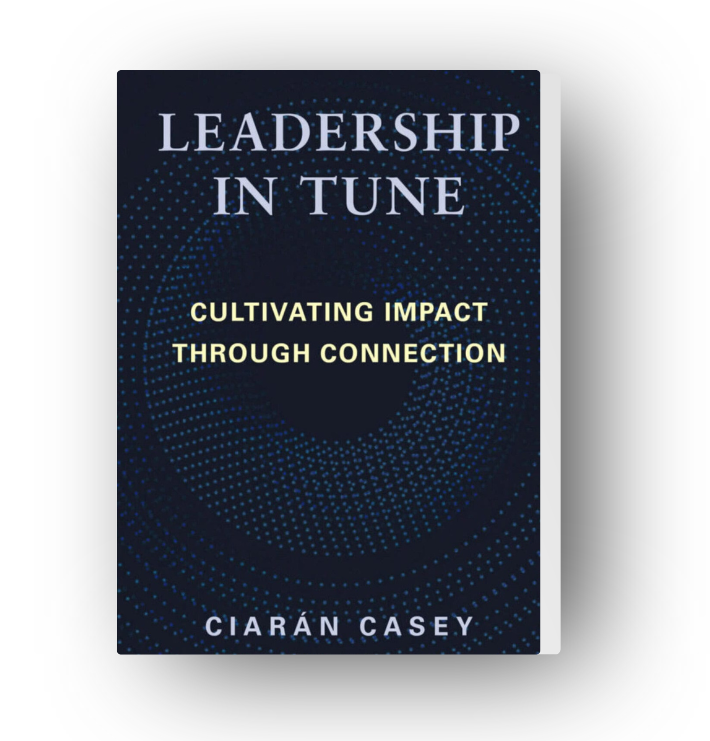
Leadership In Tune:
Cultivating Impact Through Connection
Blending real leadership stories, relational insight, and a practical 90-day integration plan, the book offers a reflective and grounded approach to leadership. Drawing on more than thirty years of experience, Ciarán Casey explores how connection, trust, and human dynamics shape leadership in practice.
References
Edmondson, A. C. (1999). Psychological safety and learning behavior in work teams. Administrative Science Quarterly, 44(2), 350–383.
Gallup. (2024). State of the global workplace 2024. Gallup.
Kahn, W. A. (1990). Psychological conditions of personal engagement and disengagement at work. Academy of Management Journal, 33(4), 692–724.
Uhl-Bien, M. (2006). Relational leadership theory: Exploring the social processes of leadership and organizing. The Leadership Quarterly, 17(6), 654–676.
Uhl-Bien, M., Marion, R., & McKelvey, B. (2007). Complexity leadership theory: Shifting leadership from the industrial age to the knowledge era. The Leadership Quarterly, 18(4), 298–318.