
What Is Trauma-Informed Supervision?
Trauma-informed supervision is a structured approach to professional oversight that recognises how trauma both direct and indirect shapes how people think, respond, and perform in the workplace. Rather than focusing solely on task management or performance review, trauma-informed supervision creates the conditions for honest reflection, psychological safety, and sustained high performance. For organisational leaders and managers, it means building supervisory relationships that account for the human realities your teams carry into work every day and using that awareness to lead more effectively.
Why Trauma-Informed Supervision Matters For Leaders
Most conversations about trauma-informed practice remain in clinical settings: therapy rooms, social work supervision, and healthcare. But the research is clear that the workplace is not exempt from trauma's effects. Gallup's 2024 engagement data shows that only 21% of employees are fully engaged at work, while highly engaged teams demonstrate up to 78% lower absenteeism. Bersin's 2025 research reinforces this, finding that 66% of employees are struggling or suffering in workplace cultures that fail to support them.
These are not welfare statistics they are performance metrics. When leaders ignore the impact of stress, vicarious trauma, and psychological harm in their teams, the costs show up in turnover, presenteeism, conflict, and stalled collaboration. Trauma-informed supervision addresses these dynamics at source: not by turning managers into therapists, but by equipping them with a framework for leading with greater awareness and accountability.
Core Principles of Trauma-Informed Supervision
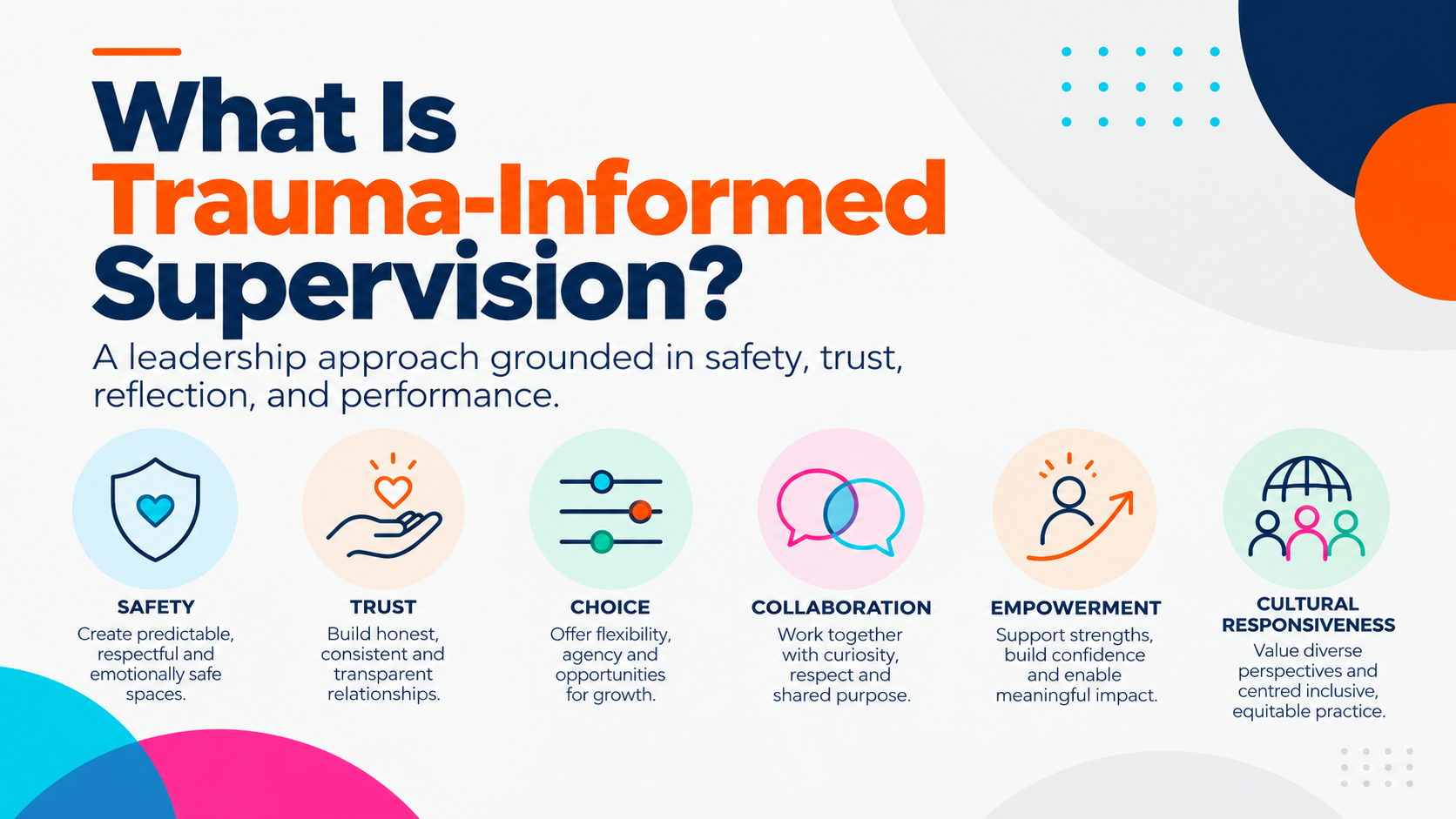
The clinical literature identifies five foundational tenets of trauma-informed practice (Knight, 2018; Shatto & Stefurak, 2024). We have adapted these here for organisational leaders and managers translating them from therapeutic contexts into practical leadership behaviours.
1. Safety
Psychological safety is the foundation. Before people can perform, reflect honestly, or raise concerns, they need to know that doing so will not be met with punishment or dismissal. In supervision, this means creating a consistent space predictable in its structure, free from judgement in its tone where people can speak openly about what is working and what is not.
In practice: Begin supervision sessions by naming that the space is confidential and non-punitive. Use consistent scheduling and structure so people know what to expect.
2. Trustworthiness and Transparency
Trust is built through clarity and follow-through, not through warmth alone. Supervisees need to understand the boundaries of the supervisory relationship: what is shared, what is escalated, and how decisions are made. Ambiguity erodes trust faster than disagreement does.
In practice: Be explicit about what happens with information shared in supervision. If something needs to be raised with senior leadership or HR, say so and explain why.
3. Choice and Autonomy
Trauma often strips people of agency. Supervision that restores choice by inviting people to set agendas, identify priorities, and co-design solutions counteracts that dynamic. This is not permissiveness; it is a deliberate leadership strategy that increases ownership and engagement.
In practice: Ask supervisees what they want to focus on at the start of each session. Offer options rather than directives wherever possible.
4. Collaboration
Trauma-informed supervision positions the supervisor as a thinking partner, not an authority dispensing answers. Collaborative supervision recognises that the person closest to the work often has the deepest insight into what needs to change. The supervisor's role is to help surface that insight, challenge assumptions, and support decision-making.
In practice: Replace "Here's what you should do" with "What have you considered so far?" and "What would need to be true for that approach to work?"
5. Empowerment
The goal of trauma-informed supervision is not dependency but capacity-building. Effective supervision strengthens the supervisee's ability to navigate complexity, regulate their responses, and lead with greater confidence. It moves people from reactivity to reflective practice.
In practice: Acknowledge growth explicitly. Ask supervisees to identify what they have handled well, not only what they are struggling with.
6. Cultural Responsiveness
Trauma does not exist in a vacuum. It intersects with identity, power, and systemic inequality. Supervision that ignores these dimensions risks reinforcing the very dynamics it aims to address. Leaders must be willing to examine how organisational culture, bias, and structural barriers shape the experiences of different team members.
In practice: Ask yourself and your supervisees whose perspectives are centred in your team's decision-making, and whose are routinely absent.
Three Myths About Trauma-Informed Supervision
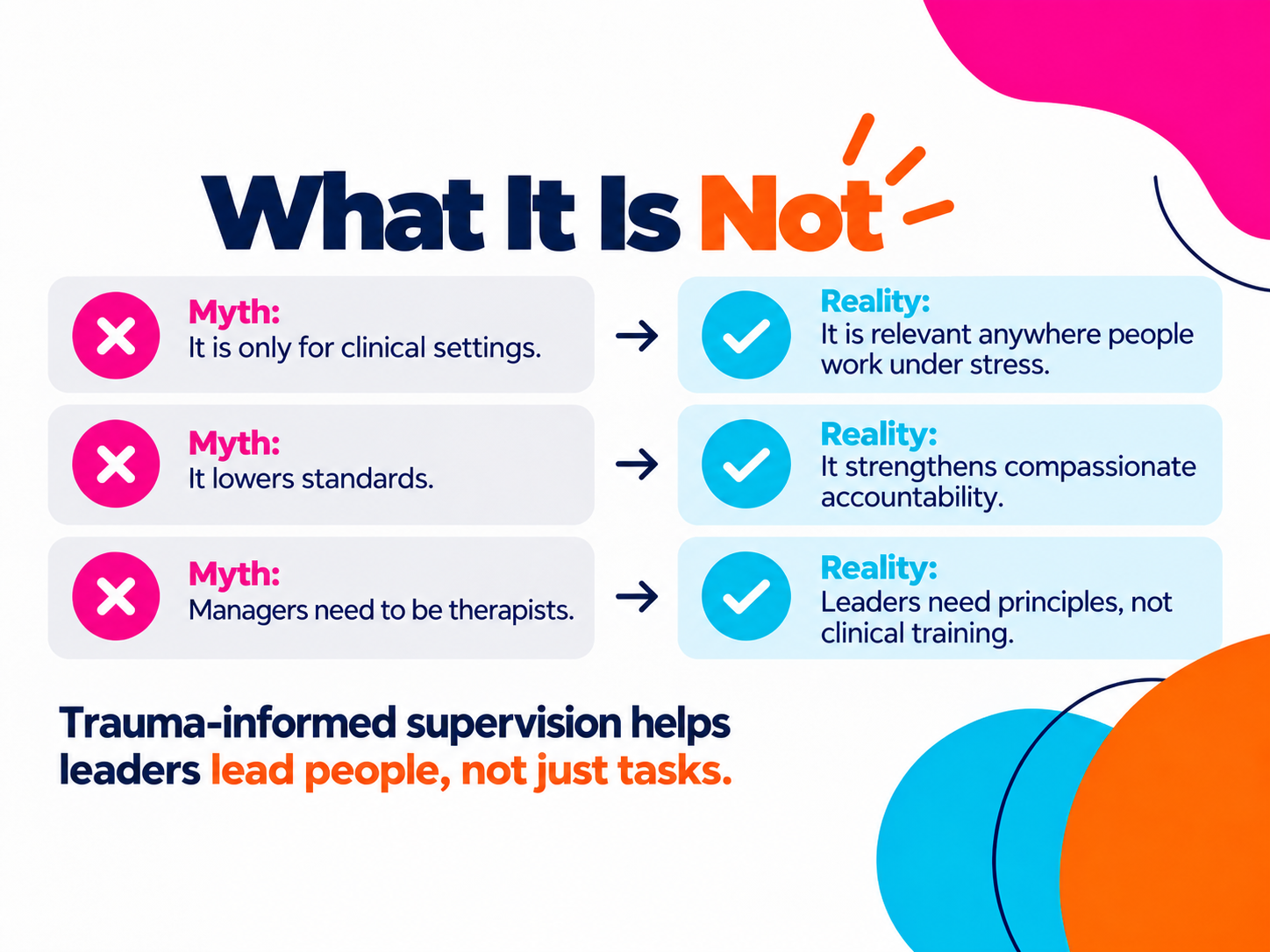
"This is only relevant for clinical settings." Trauma-informed supervision originated in therapeutic contexts, but its principles safety, trust, collaboration, empowerment are foundational to effective leadership in any sector. The question is not whether your team is affected by stress and adversity, but whether your supervisory approach accounts for it.
"It means lowering standards or avoiding difficult conversations." The opposite is true. Trauma-informed supervision enables harder conversations by building the relational foundation that makes honest dialogue possible. Compassionate accountability is not a contradiction it is the mechanism through which sustainable performance is built.
"Managers need clinical training to do this." You do not need to be a therapist. You need to understand the principles, recognise when someone's responses may be shaped by past or ongoing stressors, and adjust your approach accordingly. The shift is from "What is wrong with this person?" to "What has happened, and what does this person need to perform at their best?"
Where Trauma-Informed Supervision Meets Inclusive Leadership
At ELIS Advantage, we see trauma-informed supervision as an essential component of inclusive leadership not an optional extra or a specialist concern. Our Include-Performance Framework™ connects the conditions people need to thrive with the outcomes organisations need to succeed. Supervision sits squarely within that framework: it is one of the most direct ways leaders shape culture, build trust, and sustain performance over time.
In Inclusive Leadership: Navigating Organisational Complexity, we explore how leadership behaviours at the individual and relational level including how supervision and reflective practice are structured determine whether organisations create environments where people can genuinely perform. Trauma-informed supervision is one application of the broader principle that effectiveness over performance means focusing on what actually works for people, not what looks good on paper.
We also practise what we teach. Our Monthly One-on-One Supervision is built around psychologically aligned, trauma-informed, and anti-oppressive approaches offering practitioners a structured, year-long supervisory relationship grounded in reflective practice and sustained professional growth.
Key Takeaways
Trauma-informed supervision is a leadership framework, not a clinical tool. It equips managers to lead with greater awareness of how stress, adversity, and identity shape workplace behaviour and performance.
The core principles safety, trustworthiness, choice, collaboration, empowerment, and cultural responsiveness translate directly into practical supervisory behaviours that build trust, engagement, and accountability.
It does not mean lowering standards. It means building the relational conditions that make honest dialogue, sustained performance, and genuine inclusion possible.
Cultural responsiveness is essential. Effective trauma-informed supervision accounts for how power, identity, and systemic dynamics shape people's experiences at work.
Organisations that embed trauma-informed approaches into supervision and leadership practice are better positioned to retain talent, reduce disengagement, and build cultures of compassionate accountability.
Making Trauma-Informed Leadership Part of Everyday Practice
Trauma-informed supervision is not a niche clinical practice it is a leadership capability that belongs in every organisation serious about performance, retention, and inclusion. When leaders understand how stress, adversity, and identity shape behaviour at work, they can build supervisory relationships that unlock honest dialogue, strengthen accountability, and sustain engagement over time. The principles are straightforward: safety, trust, choice, collaboration, empowerment, and cultural responsiveness. The shift is from managing tasks to leading people with the awareness and intentionality that complex, human workplaces require.
If you are ready to embed trauma-informed, reflective practice into your leadership approach, explore our Monthly One-on-One Supervision a structured, year-long programme grounded in psychologically aligned and anti-oppressive principles. Or download the free Inclusive Leaders Pocket Guide to begin moving from intent to action today.
APA 7 references
Bersin, J. (2025). Employee engagement and happiness crisis. Josh Bersin Academy.
Gallup. (2024). Q12 meta-analysis: 11th edition. Gallup.
Knight, C. (2018). Trauma-informed supervision. The Clinical Supervisor, 37(1), 7–26.
Shatto, E. H., & Stefurak, J. (2024). Trauma-informed supervision. Journal of Counselor Preparation and Supervision, 17(5).