
Most leaders arrive at their first leadership coaching conversation unsure of what coaching actually is. They're not sure what to bring, whether they need to have a problem ready, or whether their organisation arranged it because someone is concerned about them. That uncertainty is more common than people admit, and it's worth naming directly.
Leadership coaching is a structured, one-to-one or group process that helps leaders think more clearly, lead more effectively, and close the gap between where they are and where they want to be. It is not a quick fix, and it is not a course. It is a working relationship built around your specific challenges, your context, and the outcomes you want to achieve.
At ELIS Advantage, we have had versions of this conversation with leaders across Ireland many times, from senior executives navigating organisational complexity to mid-level managers stepping into leadership for the first time. What follows is a clear picture of what coaching is, who it serves, how it works in practice, what you can realistically expect from it, and how to choose the right coach when you're ready to begin.
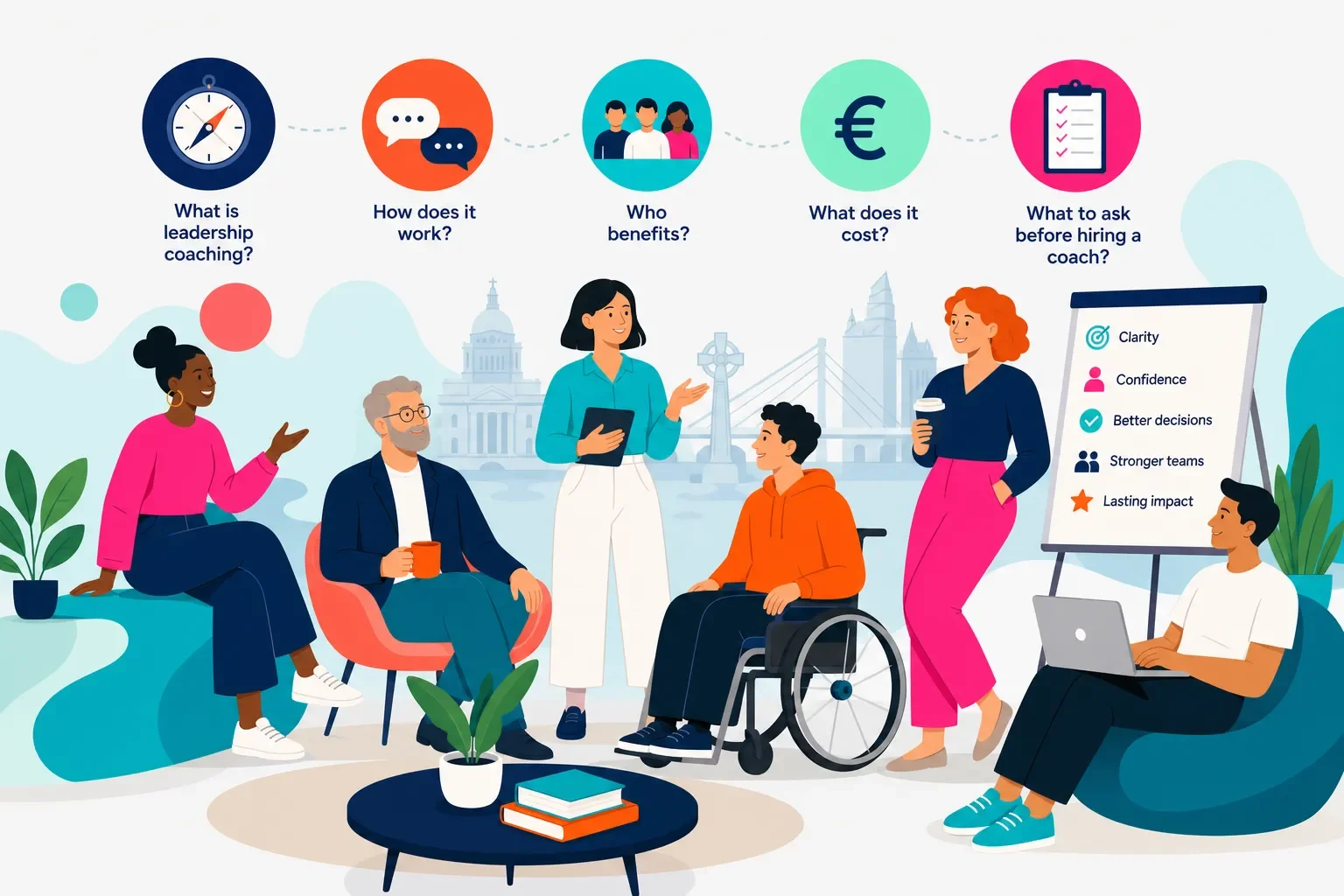
A colorful vector illustration depicting a diverse group of professionals in a modern room discussing leadership coaching, with a city skyline background and a flowchart above them detailing five key questions. Dark Blue Circle with Compass: "What is leadership coaching?" Orange Circle with Speech Bubbles: "How does it work?" Teal Circle with Three People Silhouettes: "Who benefits?" Light Green Circle with Euro Sign (€): "What does it cost?" Magenta Circle with Clipboard Checklist: "What to ask before hiring a coach?" Characters & Scene Details (Left to Right) Woman on Left: A Black woman in a bright pink top, dark blue cropped trousers, and white sneakers sits on a curved teal bench, gesturing outward as she speaks. Seated Man: A mature man with short gray hair, glasses, and a beard, wearing a dark blue blazer and teal trousers, sits in an orange armchair holding a coffee mug. Standing Facilitator/Coach: A woman with dark hair in a light blue button-down shirt and wide-leg white trousers stands near the center holding a tablet and gesturing to the group Man in Wheelchair: A young man in a bright orange hoodie and dark pants sits in a manual wheelchair, facing the group and listening attentively. Standing Woman: A woman with wavy reddish-orange hair in a dark blue V-neck top and bright pink trousers stands near a flip chart, holding a coffee cup.
What leadership coaching actually is
Many leaders conflate coaching with mentoring, training, or therapy, and that confusion leads some to rule it out on the wrong assumptions.
Mentoring is largely about transferring experience: someone who has done the job shares what they know with someone learning it.
Unlike leadership training programmes, which deliver content, frameworks, tools, and skills through a structured programme, coaching is goal-directed and built around your specific context.
Therapy addresses psychological wellbeing, often by working through past experiences with a qualified clinician.
Coaching is different from all three.
Coaching is a structured dialogue that sharpens your thinking and shifts the specific behaviours that are holding you back. The coach does not tell you what to do. They ask better questions than you are currently asking yourself, hold you accountable to what you say matters, and create enough challenge and support to shift how you see and respond to the situations in front of you.
Underneath every good coaching conversation is a methodology: goal or outcome directed, evidence-informed, and built around your specific context rather than a generic curriculum. Coaches draw on frameworks such as the GROW model or systemic coaching approaches, but the methodology stays largely in the background. As a leader, you get a focused, confidential conversation with real challenge and real accountability built in. That is meaningfully different from well-intentioned advice wrapped in coaching language.
Who benefits most from coaching for leaders
Leadership coaching is not exclusively for leaders in difficulty. It is equally valuable, often more so, for high-performers navigating complexity, for leaders stepping into larger roles, for managers working through confidence or imposter syndrome, and for executives who want to lead more inclusively and effectively. The common thread is not struggle; it is a leader who has real challenges worth working through and the willingness to do that work.
Leadership transition coaching is one of the highest-value use cases. The move into a senior role is where most leaders either consolidate or unravel their effectiveness. The skills that made someone excellent at one level do not automatically transfer to the next. Coaching at that juncture is not remedial; it is strategic. It shortens the transition curve and reduces the costly derailment patterns that affect even strong leaders when the context changes faster than their approach does.
That said, coaching works best under specific conditions. The leader needs to be willing to engage genuinely, to bring real challenges to sessions rather than rehearsed summaries, and to have the psychological capacity to reflect and act between sessions. Coaching is not the right tool when the underlying issue is a structural organisational problem, a performance management situation that requires direct management intervention, or a clinical mental health concern. Naming what coaching is not for is part of being honest about what it is.
How leadership coaching programmes work in practice
There are two primary formats in use across Ireland.
One-to-one coaching, sometimes called executive coaching or 1-to-1 coaching, is the most common. The leader works directly with a coach in regular, confidential sessions focused entirely on their goals, their challenges, and their development.
Group or cohort-based coaching brings a small number of leaders together in facilitated sessions that combine peer learning with individual reflection, and it works particularly well when an organisation wants to build a shared leadership culture rather than develop individuals in isolation.
At ELIS Advantage, our coaching offer spans both formats.
Individual one-to-one leadership coaching is designed around the specific needs of the leader and their organisational context, not off-the-shelf content.
A needs-based approach means the coach begins by establishing precisely what the leader is working through, what success looks like, and what organisational pressures are shaping the challenge.
Group programmes are structured around what the organisation and the cohort actually need, which means no two are identical. That grounding in real context is what makes the work stick.
In terms of commitment: sessions in Ireland typically run 60 to 90 minutes, scheduled fortnightly or monthly. A shorter engagement might run 3 to 4 months, covering a specific challenge or transition. A deeper leadership development journey can span 6 to 12 months. The right duration depends on the goals and the complexity of what you are working through. Coaching is not a quick fix, and it is worth saying that plainly so expectations are realistic from the outset.
Leadership coaching outcomes and ROI
The most consistent outcomes from well-structured coaching for leaders include improved self-awareness, better decision-making, clearer communication, better relationships and stronger ability to manage teams through complexity. Leaders working through imposter syndrome or significant career transitions frequently report meaningful gains in confidence. These changes are real, but they tend to be gradual rather than dramatic, and they require the leader to show up fully to the process between sessions, not only during them.
For organisations commissioning coaching, the question of return on investment is legitimate and worth addressing directly. Well-designed coaching engagements produce measurable outcomes including improvements in 360-degree feedback scores, increases in team engagement, stronger retention of high-performing staff, and faster progression through succession pipelines.
A joint ICF and PwC study reported a median return of around seven times the investment across large samples of coached leaders; when employee retention costs are factored in, the ICF notes that figures tend to be even stronger.
Financial ROI is harder to isolate cleanly, and that is worth acknowledging. The strongest evaluations combine early leading indicators, such as behavioural change and goal progress, with lagging indicators tracked over 6 to 18 months, including retention, engagement, and performance. Organisations that define a clear baseline before the programme begins are far better positioned to make a credible case for the return they achieved.
How to choose the right leadership coach in Ireland
Not everyone offering coaching has meaningful training. In Ireland, the most trusted accreditations come from the International Coaching Federation (ICF), which issues ACC, PCC, and MCC credentials at increasing levels of demonstrated competence, and the European Mentoring and Coaching Council (EMCC), whose Practitioner and Senior Practitioner levels are particularly valued in the Irish and UK market. Programmes aligned to the Irish NFQ/QQI framework also carry credibility. For most leadership and executive coaching engagements, ICF PCC or EMCC Senior Practitioner is the level worth prioritising. MCC and EMCC Master Practitioner carry the strongest signal for senior leadership or C-suite work.
For leaders and organisations exploring executive coaching in Ireland, cost is a practical consideration. In 2026, leadership and executive coaching typically runs from €200 to €450 per session, with a coaching package or programme generally ranging from €500 to €1,500 for a shorter engagement and €2,500 to €6,000 or above for a structured executive programme.
More intensive corporate programmes can exceed that range. Knowing this helps organisations budget realistically rather than being surprised or, equally, underpaying for a poor fit.
When you meet with a potential coach for an initial consultation, the quality of your questions determines how well-positioned you are to make the right decision. Consider asking:
What types of leaders do you typically work with, and how does my role and context compare?
How do you define success in a coaching engagement, and how will we measure it?
What is your coaching philosophy and methodology?
How do you handle confidentiality when an organisation is sponsoring the work?
What would a typical engagement look like in terms of frequency, format, and duration?
In what situations would you recommend training, mentoring, or another intervention instead of coaching?
These questions shift you from passive buyer to informed decision-maker, which is exactly where you should be going into this process. Fit matters as much as credentials. A highly credentialed coach whose approach does not suit your context or communication style will deliver less than a well-matched coach at a comparable level.
A final thought before you decide
Leadership coaching is not complicated, but it is often misunderstood. What matters most is this: the right coach, working on the right challenge, with a leader who is ready to engage, produces outcomes that general management development rarely matches. Choosing the right leadership coach in Ireland is ultimately about fit, the coach's experience, methodology, and accreditation need to align with what you are actually working through, not with a generic idea of what a leader is supposed to need.
If this has clarified what coaching could do for you or your organisation, the natural next step is a conversation. At ELIS Advantage, we offer free initial consultations for leaders who are curious whether one-to-one or group coaching is the right fit for where they are right now. We offer an initial conversation with no agenda beyond understanding what you are working through and whether we are well placed to support it. Get in touch with our team, and we will take it from there.
