
Leadership Content Is Everywhere; But Are We Actually Becoming Better Leaders?
Leadership books on Audible, leadership books on Amazon, leadership books PDFs, podcasts, summaries, online courses, and social media clips have made leadership content more accessible than ever before. The accessibility of leadership books, podcasts, audiobooks, and online learning has expanded dramatically, yet many organisations still report challenges with engagement, burnout, communication, and trust.
But access to leadership content does not automatically create leadership capability.
This is one of the growing challenges within modern leadership development. Many professionals consume large amounts of leadership advice while still struggling with communication breakdowns, relational tension, conflict avoidance, burnout, and team disengagement in practice. Gallup (2024) continues to report widespread employee stress and disengagement globally, suggesting that leadership effectiveness depends on more than access to information alone.
Leadership in Tune explores leadership from a different perspective. Rather than focusing on leadership “hacks” or motivational formulas, the book introduces the Conscious Relational Impact (CRI) Model™, grounded in conscious alignment and relational awareness.
The central premise of Leadership in Tune is simple but powerful: leadership succeeds or fails in the space between people. This perspective aligns with relational leadership theory, which views leadership as something that emerges through interaction, relationships, and social processes rather than individual authority alone (Uhl-Bien, 2006).
In many organisations, the challenge is not a lack of leadership information. The challenge is integration. Leaders often know what they would like to do, but relational complexity, pressure, habits, emotional responses, and organisational systems can make leadership difficult in practice. Research on engagement suggests that workplace conditions, relationships, and psychological experiences strongly shape whether people feel connected, motivated, and able to contribute meaningfully at work (Kahn, 1990).
This is why experiential leadership development and reflective leadership practice are becoming increasingly important within modern organisations. Research on emotional intelligence and resonant leadership also highlights the importance of emotional awareness, reflection, and relational attunement within effective leadership practice (Goleman et al., 2002).
Leadership in Tune combines practical leadership experience with insights into trust, collaboration, conflict dynamics, organisational culture, and human-centred leadership.
For readers searching for leadership books online, leadership audiobooks, or leadership books recommended for modern workplaces, the book offers more than passive learning. It encourages reflective practice, conscious response, and relational leadership development. Psychological safety research also suggests that people are more likely to learn, contribute, and collaborate effectively when workplace relationships feel safe and supportive (Edmondson, 1999; Edmondson & Lei, 2014).
As leadership psychology continues to evolve, many organisations are recognising that sustainable leadership is less about consuming more information and more about understanding relational impact in real organisational contexts. Complexity leadership research reinforces this shift by highlighting that modern organisations require adaptive, relational, and collaborative leadership approaches within dynamic human systems (Uhl-Bien et al., 2007).
If you are exploring leadership books on Audible, leadership books on Amazon, or leadership books for practical leadership development, Leadership in Tune provides a grounded and human-centred approach.
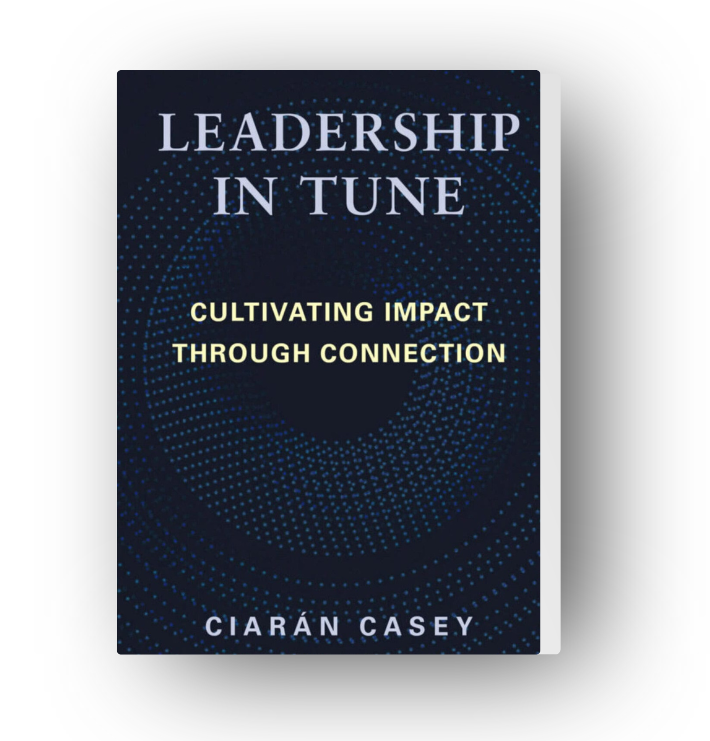
Leadership In Tune:
Cultivating Impact Through Connection
Blending real leadership stories, relational insight, and a practical 90-day integration plan, the book offers a reflective and grounded approach to leadership. Drawing on more than thirty years of experience, Ciarán Casey explores how connection, trust, and human dynamics shape leadership in practice.
References
Edmondson, A. C. (1999). Psychological safety and learning behavior in work teams. Administrative Science Quarterly, 44(2), 350–383.
Edmondson, A. C., & Lei, Z. (2014). Psychological safety: The history, renaissance, and future of an interpersonal construct. Annual Review of Organizational Psychology and Organizational Behavior, 1, 23–43.
Gallup. (2024). State of the global workplace 2024. Gallup.
Goleman, D., Boyatzis, R. E., & McKee, A. (2002). Primal leadership: Realizing the power of emotional intelligence. Harvard Business Review Press.
Kahn, W. A. (1990). Psychological conditions of personal engagement and disengagement at work. Academy of Management Journal, 33(4), 692–724.
Uhl-Bien, M. (2006). Relational leadership theory: Exploring the social processes of leadership and organizing. The Leadership Quarterly, 17(6), 654–676.
Uhl-Bien, M., Marion, R., & McKelvey, B. (2007). Complexity leadership theory: Shifting leadership from the industrial age to the knowledge era. The Leadership Quarterly, 18(4), 298–318.