
The Best Leadership Books in 2025/2026 Are Becoming More Human
The leadership world is changing. Increasingly, the best leadership books in 2025 and 2026 are moving away from purely transactional leadership models and towards more relational, psychological, and human-centred approaches. Many of the best leadership books in 2025/2026 are increasingly focused on trust, emotional intelligence, communication, psychological safety, and human-centred leadership rather than authority or productivity alone.
Traditional leadership books often focused heavily on authority, influence, productivity, decision-making, or strategic execution. While these areas remain important, organisations are now recognising that leadership effectiveness also depends on trust, communication, collaboration, emotional regulation, and relational awareness. Research on relational leadership theory suggests that leadership effectiveness emerges through relationships, collaboration, and social interaction rather than individual traits alone (Uhl-Bien, 2006).
This shift is happening because workplaces themselves have changed.
Burnout, hybrid working, rapid organisational change, disengagement, conflict, and growing complexity have highlighted the limitations of command-and-control leadership styles. Gallup (2024) reported that global employee engagement remains low, while stress and burnout continue to affect large parts of the workforce, reinforcing the need for leadership approaches grounded in connection, trust, and meaningful workplace relationships.
Leadership in Tune reflects this broader evolution in leadership thinking.
Through the Conscious Relational Impact (CRI) Model™, Leadership in Tune reframes leadership as attunement: the capacity to notice relational dynamics and respond consciously within human systems. This perspective also aligns with complexity leadership theory, which highlights that modern organisations increasingly require adaptive, relational, and collaborative leadership approaches within dynamic human systems (Uhl-Bien et al., 2007).
Rather than treating leadership as a fixed set of behaviours, the book explores how connection, trust, collaboration, and relational presence shape leadership impact over time. Psychological safety research similarly suggests that people are more likely to contribute ideas, collaborate, learn, and engage effectively when workplace relationships feel safe and supportive (Edmondson, 1999; Edmondson & Lei, 2014).
This perspective aligns with growing interest in leadership psychology books, visionary leadership books, and leadership books focused on organisational culture and human behaviour. Research on emotional intelligence and resonant leadership also reinforces the importance of emotional awareness, empathy, and relational connection within effective leadership practice (Goleman et al., 2002).
Leadership in Tune draws on more than thirty years of senior leadership experience across multiple sectors alongside practical work in mediation, leadership development, and organisational transformation.
For leaders searching for new leadership books 2025/2026, leadership books with case studies, or leadership books for business, the book offers practical insights grounded in real organisational environments rather than abstract theory alone. Research on employee engagement also suggests that people engage more fully when workplace environments support psychological presence, trust, and meaningful interpersonal connection (Kahn, 1990).
The future of leadership increasingly depends on the ability to navigate complexity, relationships, uncertainty, and emotional dynamics with intention and awareness.
As leadership conversations continue to evolve, books like Leadership in Tune are helping redefine leadership beyond control and towards conscious relational impact.
If you are looking for the best leadership books 2025/2026 or leadership books that explore communication, trust, culture, and relational leadership, Leadership in Tune is available for pre-order now.
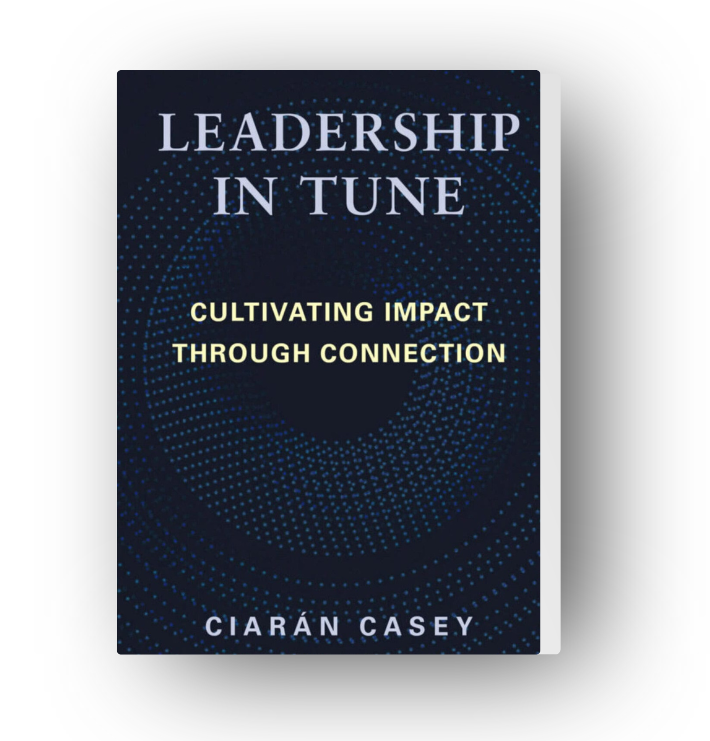
Leadership In Tune:
Cultivating Impact Through Connection
Blending real leadership stories, relational insight, and a practical 90-day integration plan, the book offers a reflective and grounded approach to leadership. Drawing on more than thirty years of experience, Ciarán Casey explores how connection, trust, and human dynamics shape leadership in practice.
References
Edmondson, A. C. (1999). Psychological safety and learning behavior in work teams. Administrative Science Quarterly, 44(2), 350–383.
Edmondson, A. C., & Lei, Z. (2014). Psychological safety: The history, renaissance, and future of an interpersonal construct. Annual Review of Organizational Psychology and Organizational Behavior, 1, 23–43.
Gallup. (2024). State of the global workplace 2024. Gallup.
Goleman, D., Boyatzis, R. E., & McKee, A. (2002). Primal leadership: Realizing the power of emotional intelligence. Harvard Business Review Press.
Kahn, W. A. (1990). Psychological conditions of personal engagement and disengagement at work. Academy of Management Journal, 33(4), 692–724.
Uhl-Bien, M. (2006). Relational leadership theory: Exploring the social processes of leadership and organizing. The Leadership Quarterly, 17(6), 654–676.
Uhl-Bien, M., Marion, R., & McKelvey, B. (2007). Complexity leadership theory: Shifting leadership from the industrial age to the knowledge era. The Leadership Quarterly, 18(4), 298–318.