
What Is ELIS Advantage?
We are ELIS Advantage (Effective Leadership & Inclusive Solutions) a leadership development and organisational consultancy that helps organisations achieve high performance through effective leadership and inclusive solutions. Founded by Síle Walsh, our approach is data-driven, needs-based, and sustainable, designed to create lasting change rather than short-term fixes.
Most organisations recognise that leadership effectiveness and inclusion matter. Fewer know how to integrate them into the way work actually gets done. That is the challenge we exist to solve. We work with organisational leaders, HR and L&D professionals, coaches, and consultants to build workplaces where everyone can perform and thrive — not through one-off interventions, but through structured, evidence-based methodology that connects inclusive practice directly to organisational performance.
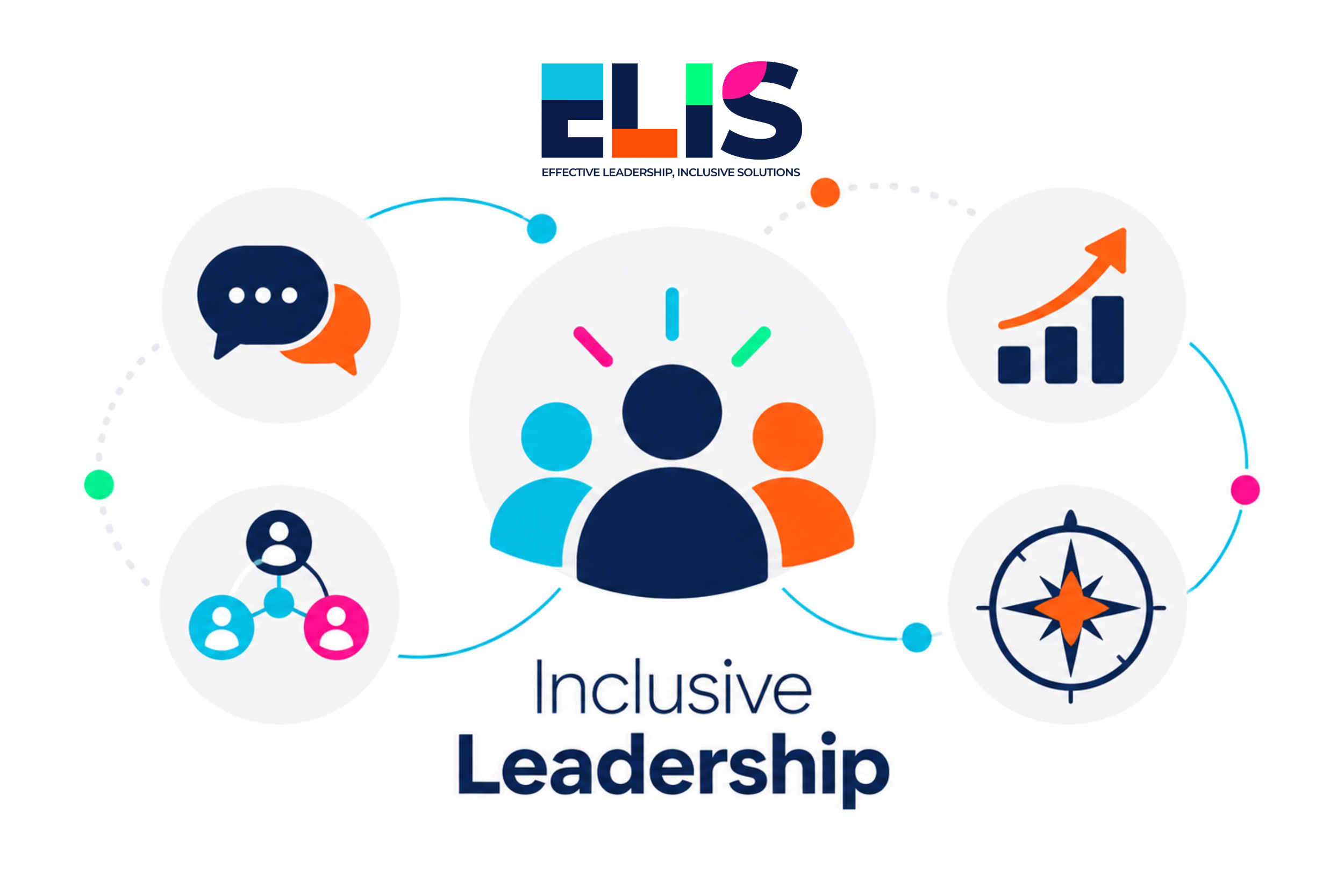
Who Founded ELIS Advantage?
ELIS Advantage was founded by Síle Walsh, a leadership specialist, award-winning and international bestselling author, and PhD candidate researching inclusive leadership from a psychological perspective. With a professional background in coaching psychology and over a decade of experience working with more than 25,000 leaders and organisations internationally, Síle brings both academic rigour and practical depth to the field of inclusive leadership.
Based in Dublin and working throughout Ireland and internationally, both in person and online. Síle is the global diversity and inclusion co-lead for the Association of Coaching. Her book, Inclusive Leadership: Navigating Organisational Complexity, is an award-winning, international bestseller that introduces the Include-Performance Framework™ and the 13 Inclusive Leadership Practices and Principles.
Why Does Inclusive Leadership Matter for Organisational Performance?
Inclusive leadership is not a compliance exercise or a box-ticking activity. It is a fundamental driver of both human wellbeing and organisational performance. Research consistently demonstrates that teams led by inclusive leaders report higher levels of psychological safety, stronger collaboration, and greater willingness to contribute discretionary effort.
The real-world impact is measurable. Organisations that embed inclusive leadership into their systems and culture see improved retention, reduced conflict, stronger innovation, and more consistent team performance. When people feel they belong and that their contributions matter, they engage more fully and that engagement translates directly into results.
At ELIS Advantage, we bring together two priorities that are often treated separately: leadership effectiveness and inclusion. We believe these are not competing interests but interconnected conditions for sustained organisational success. This integration is the foundation of our Effective Leadership Method a methodology that embeds inclusive practice into every dimension of leadership development, from individual coaching to organisation-wide strategy.
What Are the Core Principles and Services of ELIS Advantage?
Our work is guided by five principles that shape everything we do from one-to-one coaching to organisation-wide development programmes. These principles are not abstract ideals; they are practical commitments that inform how we design, deliver, and evaluate our work.
1. Fierce Conversations
We believe that meaningful progress begins with honest dialogue. Fierce conversations are evidence-informed exchanges that surface what really matters for performance, inclusion, and progress even when the topic is uncomfortable. For example, when working with a leadership team struggling with low engagement scores, we facilitate direct conversations about the systemic factors contributing to disengagement rather than treating symptoms with surface-level initiatives.
2. Compassionate Accountability
When accountability operates without care it becomes punitive, and when care operates without accountability it becomes passive — sustainable change requires both elements to function together. We support people and systems to take responsibility for their actions and their impact while providing the conditions for growth. In practice, this means helping a leader recognise how their communication style affects team psychological safety, while also providing the structured support they need to change their behaviour sustainably.
3. Aligned Action
Solutions must be grounded in organisational needs and context. We ensure that strategy, behaviour, and systems move in the same direction. When an organisation says it values inclusion but its evaluation processes, promotion criteria, and meeting structures do not reflect that value, misalignment undermines trust and performance. We help organisations identify and close those gaps.
4. Effectiveness over Performance
We focus on what works in practice, not what ticks boxes. This means prioritising interventions that are evidence-based and tailored to the specific context of each organisation. A leadership programme that transforms one team may not suit another effectiveness requires understanding the unique dynamics, pressures, and goals of the people involved. Inclusive design is embedded into every solution from the outset through our Include-Performance Framework™, which integrates inclusive practice with performance outcomes at every stage.
5. Data-Driven, Needs-Based Design
We ground every engagement in evidence not assumptions. Before designing a programme, we assess the organisation's specific context, needs, and goals through structured research and diagnostic processes. This means our interventions are tailored to what is actually happening in the organisation, not based on generic best-practice templates. A data-driven approach ensures that outcomes are measurable and that resources are directed where they will have the greatest impact on both leadership effectiveness and inclusion.
What Services Does ELIS Advantage Offer?
We deliver these principles through a comprehensive range of services:
Leadership & Development: personalised coaching, leadership team coaching, facilitation, and consulting to drive growth and collaboration
Training & Development: hands-on, real-world programmes designed for practical application and sustainable growth at all levels
Keynote Speaking: thought-provoking talks on leadership, inclusion, and high performance tailored to your organisational context
Organisational Development: workshops, strategy co-design, and tailored research to guide transformative change
Professional Supervision: reflective practice support for coaches, consultants, HR professionals, and community workers
Inclusivity in Action Masterclass: three practical inclusion strategies for leaders, available as a digital programme
Inclusive Leaders Pocket Guide: a free downloadable resource for leaders ready to move from intention to action
Consider the following questions as you reflect on your own organisation:
Are your leadership conversations honest enough to surface what really matters?
Do your systems hold people accountable while also supporting them to grow?
Is your strategy for inclusion aligned with how your organisation actually operates day to day?
Are you measuring effectiveness by what works, or by what looks good on paper?
What Are Common Misconceptions About Inclusive Leadership?
One of the most persistent misconceptions about inclusive leadership is that it is primarily about diversity metrics or compliance with equality legislation. While these are important, they represent only a fraction of what inclusive leadership involves.
Another common challenge is the assumption that inclusive leadership is a skill set that can be acquired through a single training session. In reality, inclusive leadership requires ongoing reflection, practice, and systemic support. Leaders must develop the capacity to recognise their own biases, understand intersectionality, and create conditions where diverse perspectives genuinely influence decision-making not just where they are present in the room.
We also encounter organisations that treat inclusion as separate from leadership effectiveness. Our experience working with over 25,000 leaders internationally shows that the most effective leaders are those who integrate inclusive practices into their everyday leadership, rather than treating them as a parallel initiative.
A related challenge is the tendency to adopt generic, off-the-shelf solutions without assessing whether they fit the organisation's specific context. Inclusive leadership is not one-size-fits-all, the dynamics, pressures, and goals of every organisation differ, and effective interventions must be designed accordingly.
The ELIS Advantage Perspective
Our approach is grounded in Síle Walsh's book, Inclusive Leadership: Navigating Organisational Complexity, which introduces the Include-Performance Framework™ and the 13 Inclusive Leadership Practices and Principles. These frameworks provide a structured, evidence-based methodology for leaders who want to move beyond intention and into sustained, measurable action.
The Include-Performance Framework™ connects inclusive leadership directly to organisational performance — demonstrating how inclusive practices improve decision-making quality, team cohesion, innovation, and retention. The 13 Practices and Principles offer a practical roadmap that leaders can apply across different organisational contexts and levels of complexity. For leaders looking for an accessible starting point, our free Inclusive Leaders Pocket Guide provides five research-driven strategies to begin practising inclusive leadership immediately.
Our Approach to Inclusive Leadership
ELIS Advantage stands for Effective Leadership & Inclusive Solutions a consultancy founded by Síle Walsh that helps organisations achieve high performance through inclusive leadership.
Inclusion is a performance driver, not a compliance exercise. It improves retention, psychological safety, collaboration, and team performance.
Five guiding principles fierce conversations, compassionate accountability, aligned action, effectiveness over performance, and data-driven, needs-based design shape every engagement.
The Include-Performance Framework™ and 13 Inclusive Leadership Practices and Principles provide a structured, evidence-based approach to embedding inclusive leadership into organisational systems.
Inclusive leadership is an ongoing practice, not a one-time training event. It requires sustained reflection, systemic support, and integration into everyday leadership.
Inclusive Leadership as an Everyday Organisational Practice
Inclusive leadership is not a destination it is a continuous practice of aligning how we lead with the outcomes we want to achieve. At ELIS Advantage, we believe that organisations perform at their best when leadership effectiveness and inclusion are treated as inseparable. Whether you are beginning to explore inclusive leadership or looking to deepen an existing commitment, the evidence is clear: inclusive leadership drives better outcomes for people and for organisations.
The question is not whether inclusive leadership matters. It is whether your organisation is ready to embed it into how leadership actually works in systems, in conversations, and in everyday decisions.
APA 7 references
Bersin, J. (2025). Employee engagement and happiness crisis. Josh Bersin Academy.
Coaching 4 Good. (2022). Inclusive leadership: 15 statistics on how it impacts organizations.
Gallup. (2024). Q12 meta-analysis: 11th edition. Gallup.