
What Is the Include-Performance Framework® ?
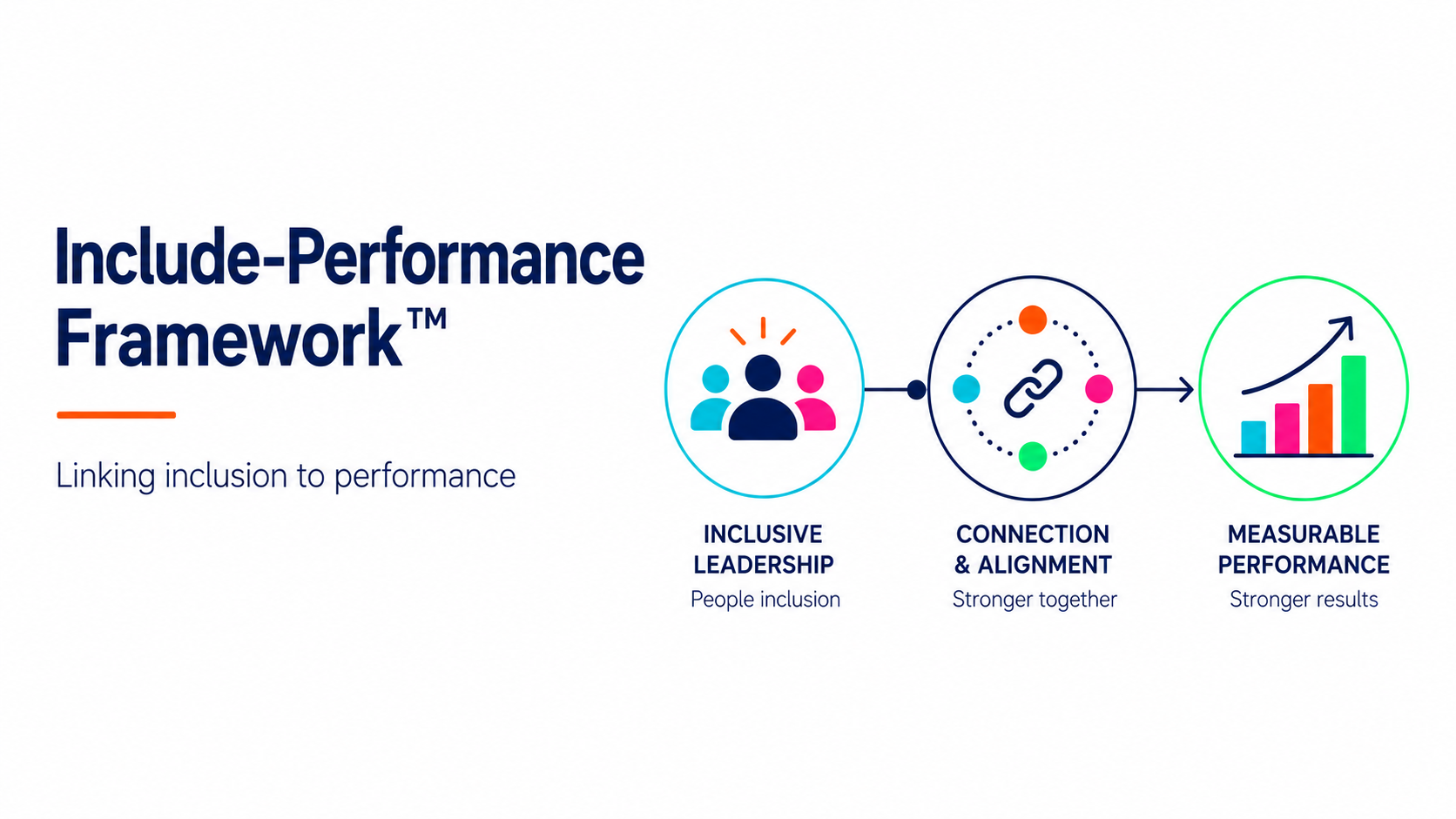
The Include-Performance Framework™ is a structured methodology developed by ELIS Advantage that connects inclusive leadership practices directly to measurable business performance outcomes. Rather than treating inclusion as a standalone initiative or compliance requirement, the framework positions it as a core driver of organisational effectiveness linking how people experience inclusion to what the organisation achieves. It provides leaders and HR professionals with a systematic approach to embedding inclusion into strategy, team dynamics, and decision-making, and then tracking the performance results that follow. Introduced in the award-winning book Inclusive Leadership: Navigating Organisational Complexity by Síle Walsh, the Include-Performance Framework™ bridges the gap between what organisations say about inclusion and what they actually deliver.
Why the Include-Performance Framework™ matters
Most organisations recognise that inclusion matters. Far fewer can explain how it drives results. According to Deloitte's 2023 research on equitable workforce outcomes, only around 30 percent of organisations actively connect their inclusion progress to business outcomes. This disconnect creates a serious problem: inclusion efforts become isolated from strategy, lose executive sponsorship, and fail to produce sustainable change.
The Include-Performance Framework™ addresses this gap directly. Gallup's 2024 meta-analysis found that highly engaged teams deliver up to 23 percent higher profitability, and inclusive practices have been associated with a 29 percent increase in collaboration across diverse teams. When teams experience psychological safety and belonging, they contribute more, stay longer, and perform better. Yet without a framework to operationalise these connections, organisations struggle to move from intention to impact.
This is where the Include-Performance Framework™ earns its place not as an aspiration, but as a practical system that aligns inclusion with the outcomes leaders are already accountable for: retention, productivity, innovation, and customer loyalty.
Core principles of the Include-Performance Framework™
The framework is built on a set of interconnected principles. Each one addresses a specific dimension of how inclusion translates into performance at individual, team, and organisational levels.
1. Integration over isolation
Inclusion is not a programme that sits alongside performance management it is embedded within it. The Include-Performance Framework™ requires leaders to integrate inclusive practices into existing systems, from hiring to promotion. For example, rather than running a separate inclusion workshop, a leadership team might redesign their quarterly review process to include perspective-taking and equitable evaluation criteria.
2. Measurement that connects to outcomes
What gets measured gets managed, but only if the measurements are meaningful. The framework links inclusion indicators such as psychological safety scores, participation equity, and representation across decision-making levels to performance data like team output, retention rates, and innovation metrics. It is about understanding the relationship between how people experience inclusion and what the organisation achieves.
3. Fierce conversations as a foundation
Honest, evidence-informed dialogue is essential. The Include-Performance Framework™ encourages leaders to surface difficult topics inequities in workload distribution, patterns of exclusion in team dynamics, or gaps between stated values and lived experience. Without these conversations, inclusion efforts remain superficial. A practical application: scheduling structured reflection sessions where teams assess whether their working norms genuinely support contribution from all members.
4. Compassionate accountability
The framework holds a dual commitment: challenge with care. Leaders are expected to set clear expectations for inclusive behaviour while also creating the conditions for people to meet those expectations. This means addressing exclusionary behaviour directly, but also investing in development and support. For instance, a manager who notices a team member consistently being talked over in meetings would both name the pattern and work with the team to establish new norms.
5. Aligned action across systems
Inclusion cannot be effective if it operates in one part of an organisation while contradictory practices persist elsewhere. The Include-Performance Framework™ emphasises alignment ensuring that talent processes, communication norms, leadership development, and reward systems all reinforce the same principles. An organisation might discover, for example, that its leadership competency framework rewards assertiveness without recognising collaborative influence, inadvertently undermining inclusive leadership behaviours.
6. Effectiveness over performance theatre
The framework prioritises what works in practice over what looks good on paper. This means evaluating inclusion efforts by their actual impact on people and outcomes, not by the number of programmes delivered or policies published. Deloitte's 2024 Global Human Capital Trends report found that organisations making genuine progress on human capital issues are nearly twice as likely to achieve their desired business outcomes. The Include-Performance Framework™ is designed to keep the focus on that genuine progress.
Common challenges and misconceptions
One of the most persistent misconceptions is that inclusion is a "soft" initiative important for culture but disconnected from hard business results. The Include-Performance Framework™ directly challenges this by requiring evidence-based connections between inclusive practices and performance data.
Another common challenge is treating inclusion as the responsibility of HR alone. The framework positions inclusive leadership as a core capability for all leaders, not a delegated function. When inclusion is seen as everyone's work, it becomes embedded in daily operations rather than confined to annual training events.
Leaders also sometimes assume that measuring inclusion means surveying employees once a year. The framework encourages ongoing, integrated measurement building inclusion indicators into the same dashboards and review cycles that track financial and operational performance.
The ELIS Advantage perspective
We developed the Include-Performance Framework™ because we saw a consistent pattern across the organisations we work with: leaders who genuinely valued inclusion but lacked a structured way to connect it to the outcomes they were responsible for delivering. The framework emerged from over a decade of working with more than 25,000 leaders internationally, combined with ongoing research into the intersection of leadership effectiveness and inclusion.
The Include-Performance Framework™ is introduced and explored in depth in Inclusive Leadership: Navigating Organisational Complexity, which provides the 13 Inclusive Leadership Practices and Principles alongside practical tools for implementation. The book reframes inclusion as a core performance and human need not an add-on or a compliance exercise and the framework is the operational backbone of that approach.
For HR and L&D professionals looking for a methodology they can bring into leadership programmes, coaching conversations, and organisational design work, the Include-Performance Framework™ offers a structured starting point. For senior leaders, it provides a way to hold themselves and their organisations accountable for the link between how people are included and how the organisation performs.
The Include-Performance Framework™ is a structured methodology that connects inclusive leadership practices to measurable business outcomes.
It addresses the gap most organisations face: valuing inclusion without systematically linking it to performance.
The framework is built on principles including integration over isolation, meaningful measurement, fierce conversations, compassionate accountability, aligned action, and effectiveness over performance theatre.
It is not a standalone programme it is designed to be embedded into existing leadership and organisational systems.
The framework is introduced in the award-winning book Inclusive Leadership: Navigating Organisational Complexity by Síle Walsh.
Where the Include-Performance Framework™ leads
The gap between valuing inclusion and achieving measurable results through it is closing but only for organisations willing to approach inclusion as a system, not a sentiment. The Include-Performance Framework™ provides the structure to make that shift: connecting leadership behaviours to team dynamics, linking team dynamics to performance data, and ensuring that inclusion is not just an aspiration but an accountable practice embedded in how the organisation operates. As the evidence base grows and leadership expectations evolve, frameworks that integrate inclusion with performance will become essential rather than optional. The organisations that adopt this approach now will be the ones best positioned to attract, retain, and develop the leaders and teams needed for the challenges ahead.
Are you ready to move from intention to impact? Explore how the Include-Performance Framework™ can reshape your approach to leadership and inclusion. Read Inclusive Leadership: Navigating Organisational Complexity to access the full framework, the 13 Inclusive Leadership Practices and Principles, and practical tools for implementation.
References
Coaching 4 Good. (2022). Inclusive leadership: 15 statistics on how it impacts organizations.
Deloitte. (2023). Equitable workforce outcomes. Deloitte Insights.
Deloitte. (2024). 2024 global human capital trends. Deloitte.
Gallup. (2024). Q12 meta-analysis: 11th edition. Gallup.