
Systemic Leadership Development Hierarchy Model: A Comprehensive Guide to Effective Leadership Growth
What if leadership development wasn’t just about the individual, but about the system they operate within?
Leadership doesn’t happen in isolation. The effectiveness of any leader is influenced by the systems they are part of from the team they lead to the broader organisation and external environment. That’s why a systemic approach to leadership development is not only more sustainable but also more impactful.
In this blog, we explore the Systemic Leadership Development Hierarchy Model, a practical and layered approach to identifying where to focus leadership development efforts for maximum return, and how different levels of the system influence outcomes.
What Is the Systemic Leadership Development Hierarchy Model?
This model evaluates leadership development across six interconnected layers. It helps you identify where development is needed most, what will have the greatest impact, and how to design interventions that align with both individual and organisational needs.
By taking a systemic approach to leadership, we can move beyond surface-level training and start embedding real, sustainable change.
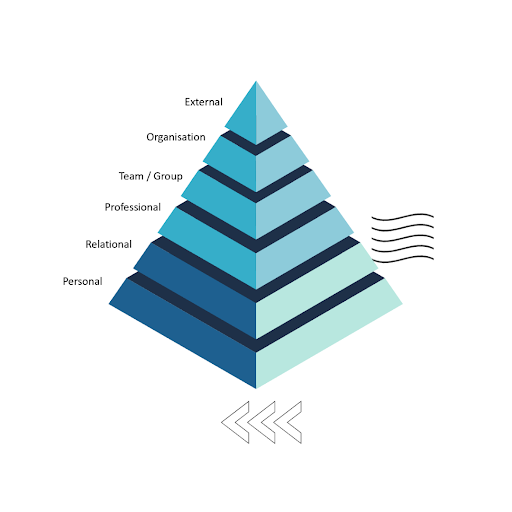
The Six Layers of the Model
Each layer in the hierarchy builds on the previous one. Development becomes more impactful when it is aligned across these levels, creating a ripple effect throughout the organisation.
Personal
Focuses on self-awareness, personal reflection, mindset, and beliefs.
This is the foundation of inclusive, values-driven, and psychologically safe leadership.
Development here includes coaching, self-assessment, and reflective practice.
Relational
Concerned with interpersonal skills, psychological safety, communication, boundaries, and emotional regulation.
A critical area for team leaders and people managers.
Investing here enhances team dynamics and individual motivation.
Team
Explores team dynamics, collaboration, and performance structures.
Developments may include group coaching, facilitated dialogues, and inclusive team strategies.
A strong team level ensures collective responsibility and co-created solutions.
Organisational
Includes systems, processes, values, policies, and learning cultures.
Misalignment here can limit the effectiveness of leaders at any other level.
Development work may focus on leadership frameworks, values integration, and organisational culture.
Structural
Encompasses power dynamics, structural inequality, legislation, and strategic positioning.
This level shapes the rules of the game: who is included, who is excluded, and how systems enable or disable equity.
Development here involves reviewing decision-making structures, leadership access pathways, and systemic equity assessments.
Societal
The broader cultural, historical, economic, and political environment.
Leaders operating systemically must be able to analyse and respond to these contexts without replicating harm.
This includes reflective learning, policy development, and social responsibility training.
Why This Model Matters in Today’s Organisations
Many leadership programmes focus only on the individual. While useful, this narrow lens often fails to address the real barriers to leadership effectiveness such as misaligned structures, conflicting team dynamics, or systemic exclusion.
A systemic leadership development model offers a map to explore not just who a leader is, but where they lead, how they lead, and what affects their capacity to lead well.
By applying this model:
HR and OD professionals can pinpoint the level where the intervention will have the greatest ripple effect.
Leaders can build awareness of how the system enables or constrains their effectiveness.
Organisations can move from reactive development to strategic, inclusive leadership design.
How to Apply the Model in Practice
When using this model to plan leadership development, ask:
Where in the hierarchy is the biggest barrier to growth?
What level, if addressed, will enable wider impact?
Is leadership being constrained by individual, relational, team, or structural dynamics?
This approach supports leadership development strategies that are data-driven, needs-based, and inclusively designed, aligning perfectly with ELIS Advantage’s core principles.
