
How to Delegate Effectively: Build Trust, Capability and Team Performance
Delegation often feels inefficient at first.
You explain the task, answer questions, review the work and correct misunderstandings. By that point, it can seem easier to do the work yourself.
That conclusion makes sense in the moment. It also creates a longer-term problem. When the leader repeatedly takes the work back, the team gets fewer opportunities to build capability, decision-making remains concentrated with one person, and the leader becomes the point through which too much work has to pass.
Delegation is not about giving work away.
It is about creating a system where your team can perform without constant supervision.
Done well, delegation protects a leader’s finite time, develops the team and improves how work moves through the organisation. Done poorly, it can feel like abandonment, create unclear accountability or add layers of checking that leave everyone frustrated.
The difference is rarely a leader’s willingness to “let go”. The difference is usually the design of the delegation.
What does effective delegation mean?
Effective delegation involves transferring an appropriate level of responsibility and decision-making authority to another person, while providing the clarity, resources, boundaries and support needed for the work to succeed.
This means delegation is more than task allocation.
A manager can allocate a task while retaining every decision, controlling every step and requiring constant updates. That is task distribution, but it offers very little ownership.
A manager can also hand over a task without context, access to information or useful support. That may look like autonomy, but it can be experienced as neglect.
Effective delegation sits between over-control and under-support. It combines clear outcomes with an appropriate level of authority, accountability and support.
Research on trust, autonomy and work design reinforces this point. Trust between employees and management is associated with greater delegation of decision-making rights, while team trust develops dynamically through repeated interactions and shared experience (Costa et al., 2018; Meagher & Wait, 2020). Autonomy is also more likely to contribute to positive outcomes when it exists within a supportive and trusting relationship with the manager (Lauring & Kubovcikova, 2022).
Why do managers find delegation difficult?
Delegation can expose several real leadership tensions.
The leader remains accountable for the outcome but no longer controls every action. The team member needs enough freedom to take ownership, but not so much uncertainty that they are left guessing. The work needs to get done now, while capability may take time to develop.
This creates understandable concerns:
“It will take longer to explain.”
“I will have to fix it later.”
“They are already busy.”
“I am not sure they are ready.”
“I am still accountable if it goes wrong.”
“I do not want to micromanage, but I also cannot disappear.”
These concerns do not mean the leader is controlling or the team member is incapable. They point to decisions that need to be made explicitly.
What is being delegated?
What authority travels with it?
What does good look like?
What support is available?
When does the person check in?
What remains with the manager?
Without those answers, delegation becomes an interpersonal gamble. With them, it becomes a work design process.
The common misunderstanding: Delegation is not all or nothing
One of the biggest delegation mistakes is treating every task as though it requires the same level of oversight. It does not. A familiar, low-risk task completed by an experienced team member can carry a high level of autonomy. A new, complex or high-risk task may need more direction, discussion and review. The same person can be highly capable in one area and completely new in another.
This means delegation needs to be task-specific, not based on a general label such as “strong performer”, “not ready” or “needs confidence”. A useful starting point is a traffic-light assessment.
The delegation traffic-light model
The traffic-light model helps a manager match support to a person’s current capability for a specific task.
Red: Little or no experience with this task
Red does not mean the person is a poor performer. It means the task, context or level of responsibility is new.
The person may benefit from:
a clear explanation of the outcome and process;
examples or a demonstration;
smaller stages of responsibility;
access to relevant information and resources;
frequent, planned feedback;
clarity about when to pause and ask for help.
The manager remains more involved because the purpose is safe learning as well as delivery.
Amber: Some capability, with support still useful
The person has some relevant skill or experience, but may not yet be ready to manage the full task independently.
The person may benefit from:
clarity about the outcome and non-negotiables;
space to suggest an approach;
agreed checkpoints at meaningful stages;
coaching questions rather than step-by-step instruction;
feedback on judgement and decision-making;
progressively wider authority as confidence and competence grow.
Amber is often where managers unintentionally over-control. The person knows enough to contribute but receives so many instructions that there is little room to practise judgement.
Green: Capable of completing the task with limited support
The person has demonstrated the relevant capability and understands the context.
The manager can focus on:
the outcome;
strategic boundaries;
available resources;
risks that need escalation;
the level and timing of updates;
the final review or learning conversation.
Green does not mean no communication. It means communication can focus on alignment and exceptions rather than constant permission. The colour belongs to the task, not the person. That distinction matters for both fairness and development.
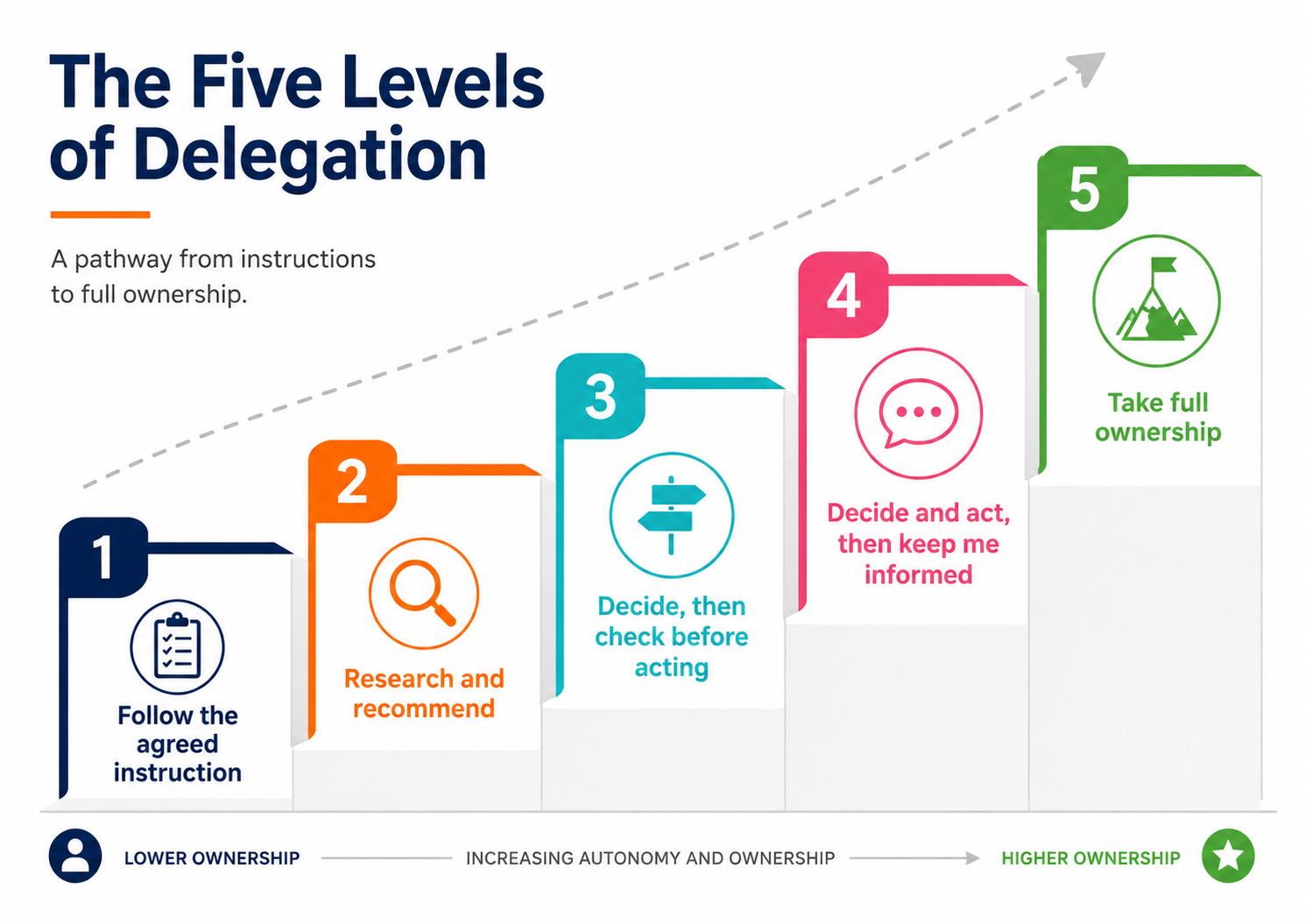
Five Levels of Delegation
Once the task and current capability are clear, the manager can choose the level of authority being delegated.
Level 1: Follow the agreed instruction
“Complete the task in this way and come back to me at the agreed point.”
This level can fit new, high-risk or tightly regulated work. The person has responsibility for execution, while the manager retains most decision-making authority.
Level 2: Research and recommend
“Explore the options and bring me your recommendation, including the risks and reasoning.”
This level develops analysis and judgement without transferring the final decision.
Level 3: Decide, then check before acting
“Make the decision and talk me through it before you proceed.”
The person practises ownership, while the manager retains a final review point.
Level 4: Decide and act, then keep me informed
“Use your judgement, take action and update me at the agreed stage.”
The person holds decision-making authority within clear boundaries.
Level 5: Take full ownership
“You own this outcome. Use your judgement and involve me when an agreed exception or risk arises.”
The manager remains accountable for the wider system, but the person has clear ownership of the task or area.
The aim is not to move every task to Level 5. The aim is to choose the level that fits the work, risk, capability and context.
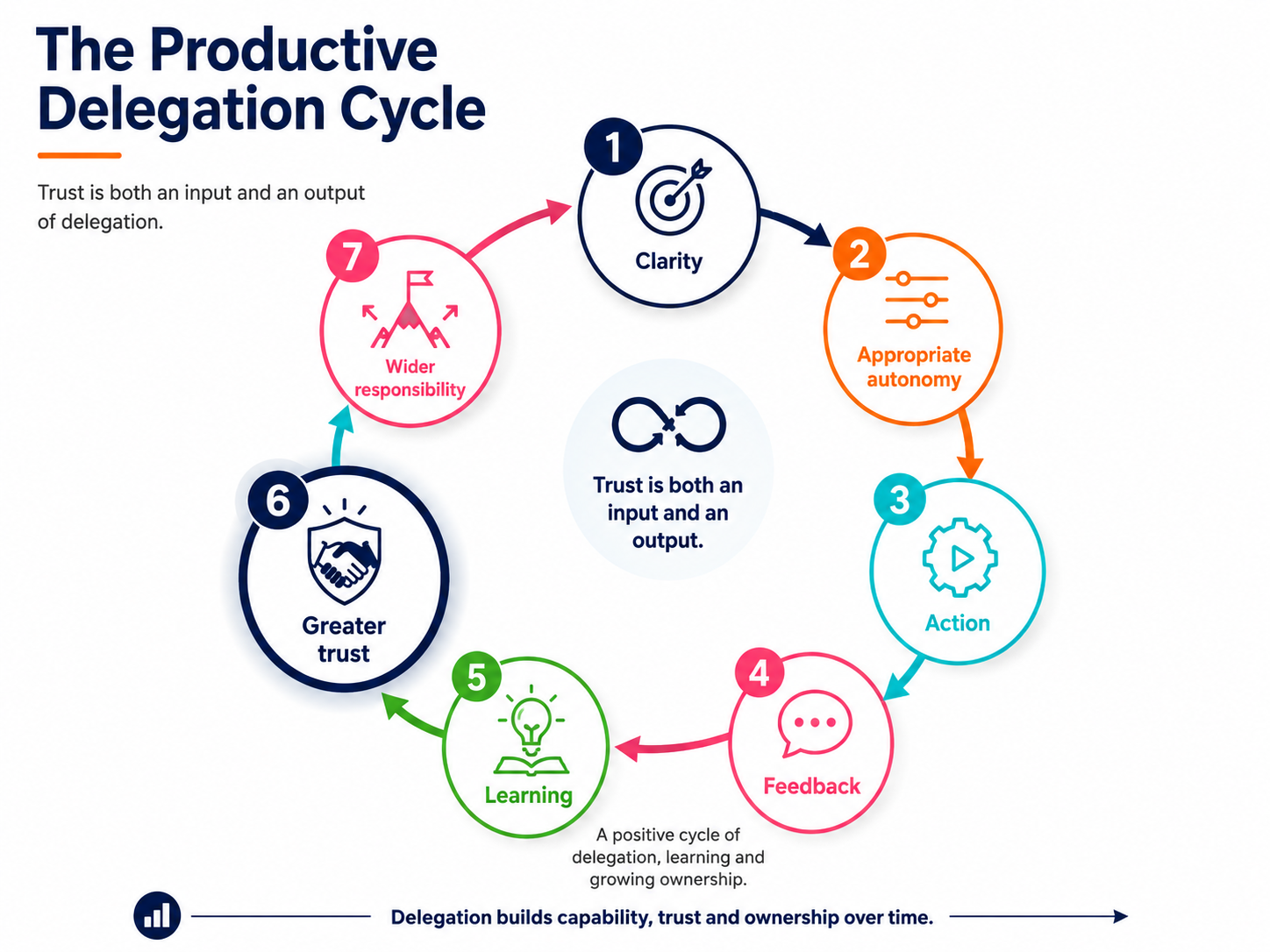
Trust is both an input and an output of delegation
Leaders often say they will delegate when they trust the person. Yet trust is not only something that exists before delegation. It is also built through well-designed experiences of responsibility.
A team member receives a meaningful piece of work, understands the boundaries, uses their judgement, asks for help when needed and delivers. The manager responds consistently, discusses mistakes without humiliation and recognises learning as well as results. Over time, both people gain evidence about reliability, competence, openness and support.
Delegation can therefore create a productive cycle:
Psychological safety is relevant here. Edmondson (1999) defined team psychological safety as a shared belief that a team is safe for interpersonal risk-taking. In delegation, those risks include asking a question, admitting uncertainty, reporting a mistake and challenging an unrealistic instruction.
A leader does not create safety by promising that nothing will go wrong. A leader contributes to safety by making it possible to surface concerns early, when action can still be taken.
Useful language includes:
“What feels unclear before you start?”
“Which part carries the most risk?”
“What information are you missing?”
“What would make you pause and bring this back to me?”
“Tell me early if the assumptions change.”
“A question now is more useful than a hidden problem later.”
This supports performance because it improves access to information. It supports people because they do not have to protect their image at the expense of the work.
Delegation is a work design decision
Delegation changes more than who completes a task. It changes the person’s work.
It can affect variety, challenge, confidence, autonomy, relationships, workload, emotional demands and access to feedback. This is why an apparently positive stretch assignment can become overwhelming, while an apparently simple task can become demotivating through excessive control.
The SMART work design model offers a useful way to review this. SMART identifies five higher-order features of work: Stimulating, Mastery, Agency, Relational and Tolerable demands (Parker & Knight, 2024).
Stimulating
Does the delegated work offer useful variety, challenge and meaning?
A stretch task can create learning and engagement when the challenge is appropriate. Too little challenge can feel repetitive. Too much complexity without support can create avoidable strain.
Mastery
Can the person see what good looks like, complete a meaningful piece of work and receive useful feedback?
Delegation is developmental when the person can connect effort with learning and progress. Fragmented tasks, vague standards or feedback that arrives only when something is wrong can undermine mastery.
Agency
What decisions can the person make about method, sequencing, timing and priorities?
Agency is not the absence of boundaries. It is meaningful discretion within a clear area of responsibility. Research on responsible autonomy highlights the value of combining autonomy with goals, coordination and trust rather than treating freedom and control as opposites (Abgeller et al., 2024).
Relational
What support, connection and interdependence does the work involve?
Delegated work can increase visibility and collaboration. It can also isolate someone from the information, relationships or influence needed to succeed. Managers can review who needs to be consulted, who can remove barriers and where peer support is useful.
Tolerable demands
Is the workload, time pressure, role conflict and emotional demand manageable?
Delegation does not solve workload when work is simply added to an already full role. A developmental opportunity can become exploitation when the person receives responsibility without time, resources, authority or recognition.
A useful reminder is:
Low performance does not automatically mean the person is the problem. It may show that the work design needs attention.
A Practical Delegation Process for Managers
The following process brings together task clarity, authority, trust and work design.
1. Define the outcome
Clarify what needs to be achieved and why it matters.
Include:
the expected result;
the reason for the work;
the deadline;
quality or success criteria;
genuine non-negotiables;
available resources.
Avoid over-specifying the method unless the process is required for safety, regulation or quality.
2. Clarify priority
A simple four-part priority lens can separate:
Required
Important
Useful
Out of scope at this stage
This reduces the risk that everything is communicated as equally urgent.
3. Assess capability and support
Use the red, amber or green traffic-light lens for this specific task.
Consider:
relevant knowledge and skill;
previous experience;
access to information;
current workload;
confidence;
relationships and stakeholder access;
support or reasonable adjustments;
the consequences and reversibility of mistakes.
4. Choose the delegation level
State clearly whether the person is being asked to:
follow an agreed process;
research and recommend;
decide and check;
decide, act and inform;
take full ownership.
This removes the common ambiguity where a leader believes they delegated a decision, while the team member believes they were only gathering information.
5. Clarify roles and decision rights
For work involving several people, a simple RACI discussion can clarify who is:
Responsible for completing the work;
Accountable for the outcome;
Consulted before relevant decisions;
Informed about progress or results.
RACI is most useful as a conversation, not as a complicated spreadsheet. The purpose is to prevent gaps, duplication and informal interference.
6. Design the support
Agree:
what information and resources are available;
what the person can decide;
what needs escalation;
when check-ins take place;
what feedback will be useful;
who else can provide input;
how changing circumstances will be handled.
The check-in needs to match the risk and development need. Constant updates can erode agency. No access to the manager can turn autonomy into neglect.
7. Confirm commitment and concerns
Ask the person to describe their understanding of the outcome, authority and next steps.
Questions could include:
“How are you thinking about approaching this?”
“What feels straightforward?”
“Where do you see uncertainty or risk?”
“What support would be useful?”
“What else is competing for your time?”
“What decision do you need from me now?”
This is not a test. It is a way to identify different interpretations before they become performance issues.
8. Review the work and the design
At the end, review both the result and the delegation process.
Discuss:
what worked;
what was harder than expected;
what decisions were made;
where support arrived too early or too late;
what could be delegated differently next time;
what new capability is now available in the team.
Delegation becomes development when learning is made visible.
What Effective Delegation Sounds like
Vague delegation often sounds like this:
“Could you take care of the client update? Use your judgement, but check everything with me before it goes out. It is urgent, so keep me posted.”
The team member is left to work out what “take care of” means, how much judgement they actually have and how often “keep me posted” requires contact.
A clearer version could sound like this:
“I would like you to own the client update for Friday. The outcome is a two-page summary of progress, risks and next steps. Accuracy and a clear explanation of the delayed milestone are the non-negotiables. You can decide the structure and draft the recommendation. Speak with finance and the project lead before finalising it. Send me your proposed position on the delay by Wednesday afternoon, and we will review that decision before the final version goes to the client. Bring it back earlier if the financial impact changes or the client raises a contractual concern.”
The second version clarifies the outcome, decision rights, consultation, review point and escalation conditions. It provides support without controlling every step.
Inclusive Delegation: Who Gets trusted with Meaningful Work?
Delegation also shapes access to opportunity. High-visibility assignments, decision-making authority and stretch work can influence development, confidence, networks and future progression. When delegation relies mainly on familiarity, personal comfort or who is most visible, the same people can repeatedly receive the opportunities that build credibility.
An inclusive delegation process could consider:
Who usually receives high-profile work?
Who receives routine work without development value?
Whose readiness is assumed, and whose readiness is repeatedly questioned?
Who has access to the information and relationships required to succeed?
Are the criteria for greater autonomy clear?
What support could make the opportunity workable for a wider range of people?
Is workload being considered alongside enthusiasm?
This is not about giving every task to everyone. It is about using relevant, transparent and needs-based criteria rather than treating trust as a vague feeling.
High performance requires everyone’s needs to be included. In delegation, that means including the needs of the task, the individual, the wider team and the organisation when deciding who takes ownership and how the work is supported.
Before, shift and after
Before . Shift . After.
The manager holds most decisions and becomes a bottleneck.
Decision rights are made explicit.
Work moves without constant permission.
Delegation means either detailed control or complete handover.
Support is matched to the task, risk and current capability.
The person receives enough direction and enough room to think.
Check-ins happen constantly or only when something goes wrong.
Review points and escalation triggers are agreed in advance.
Fewer surprises and less defensive monitoring.
The same trusted people receive the most valuable work.
Opportunities and support are reviewed using transparent criteria.
Capability and visibility are developed more fairly across the team.
Errors lead the manager to take the work back.
Results and work design are reviewed together.
Mistakes produce learning, better systems and stronger judgement.
Frequently Asked Questions about Delegation
What is the difference between delegation and dumping work?
Delegation includes context, authority, boundaries, resources and support. Dumping transfers the task while leaving the person to absorb the uncertainty, workload and consequences.
How can a manager delegate without micromanaging?
Agree the outcome, decision rights, check-in points and escalation conditions in advance. This allows the manager to stay informed without monitoring every action.
What can a manager do when someone is not ready?
Reduce the scope, provide examples, create stages, add coaching or choose a lower delegation level. Readiness can be developed through supported responsibility rather than waiting for complete confidence.
What happens when the person makes a mistake?
The response depends on the risk, impact and cause. Review whether the expectation was clear, whether the person had the necessary authority and information, what judgement was used and what needs to change. Accountability can remain clear without shame.
How does delegation build trust?
Delegation creates opportunities for people to demonstrate reliability, judgement and openness. Trust grows when expectations are clear, support is consistent and both people can discuss uncertainty or mistakes honestly. Delegation has also been linked with psychological empowerment and feedback-seeking behaviour, although effects can vary across people and contexts (Zhang et al., 2017).
Effective delegation works with people and performance together
The goal of delegation is not to remove the leader from the work. It is to place the leader’s attention where it adds the most value.
Sometimes that means giving clear instruction. Sometimes it means coaching judgement. Sometimes it means stepping back and allowing another person to own the outcome.
The effective choice depends on what is real: the task, the risk, the person’s current capability, the available support and the wider work design.
Delegation becomes effective when clarity replaces assumption, support replaces rescue, and authority matches accountability.
That is how leaders protect their time without abandoning their people. It is also how teams build the capability, trust and shared ownership needed for high performance.
Take the next step
Where delegation is creating repeated rework, unclear accountability or pressure on managers, the issue may be wider than individual time management. ELIS Advantage works with organisations to review leadership practice, work design, team dynamics and performance systems so that great work gets done while people can perform and thrive.
Related ELIS Advantage resources
References
Abgeller, N., Bachmann, R., Dobbins, T., & Anderson, D. (2024). Responsible autonomy: The interplay of autonomy, control and trust for knowledge professionals working remotely during COVID-19. Economic and Industrial Democracy, 45(1), 57–82.
Costa, A. C., Fulmer, C. A., & Anderson, N. R. (2018). Trust in work teams: An integrative review, multilevel model, and future directions. Journal of Organizational Behavior, 39(2), 169–184.
Edmondson, A. C. (1999). Psychological safety and learning behavior in work teams. Administrative Science Quarterly, 44(2), 350–383.
Lauring, J., & Kubovcikova, A. (2022). Delegating or failing to care: Does relationship with the supervisor change how job autonomy affect work outcomes? European Management Review, 19(4), 549–563.
Meagher, K. J., & Wait, A. (2020). Worker trust in management and delegation in organizations. The Journal of Law, Economics, and Organization, 36(3), 495–536.
Parker, S. K., & Knight, C. (2024). The SMART model of work design: A higher order structure to help see the wood from the trees. Human Resource Management, 63(2), 265–291.
Parker, S. K., Morgeson, F. P., & Johns, G. (2017). One hundred years of work design research: Looking back and looking forward. Journal of Applied Psychology, 102(3), 403–420.
Zhang, X., Qian, J., Wang, B., Jin, Z., Wang, J., & Wang, Y. (2017). Leaders’ behaviors matter: The role of delegation in promoting employees’ feedback-seeking behavior. Frontiers in Psychology, 8, Article 920.
