
Dialogic leadership practices sit in a fascinating place where philosophy, psychology and the daily grind of getting work done collide.
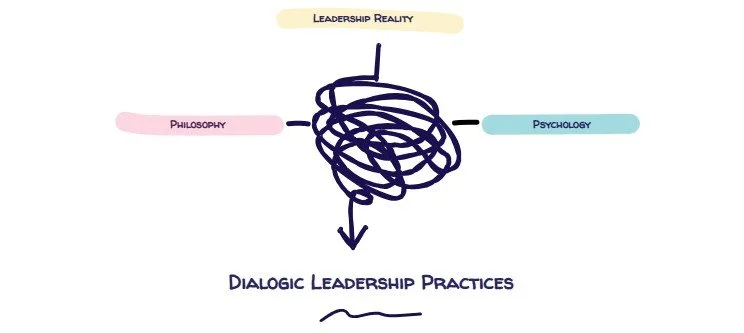
A conceptual sketch showing messy leadership reality shaped by philosophy and psychology flowing into dialogic leadership practices as a practical way to navigate complexity.
In complex environments, leaders rarely spend a lot of time trying to solve neat technical problems; they are usually navigating complexity. Leaders are most often navigating ambiguity, competing priorities and human dynamics at the same time. Leadership in this context is about moving the task forward through complexity, and the quality of that movement is strongly influenced by the quality of conversation.
When conversations fragment, task performance and organisational movement often fragment with them.
From a systems-psychodynamic perspective, leadership is understood as a property of the whole system, people, structures, roles and histories rather than simply an attribute of an individual (Lawlor et al., 2023; Meyer & Boninelli, 2007).
Conversations therefore carry not only information about the task, but also signals about systemic anxiety, conflict and unspoken tensions. Walsh’s work in inclusive leadership reinforces that leaders navigate challenges through multiple interacting factors, including how power, voice and participation are structured in everyday interactions (Walsh, 2024). Dialogic leadership practices provide a concrete way of working with those factors in real time.
Dialogic leadership treats conversations as living systems with their own anatomy.
In this theory, every productive conversation requires four kinds of action in balance. These are not personality types. They are leadership moves anyone can take at any moment to support the conversation moving forward. Leadership in these moments lies in advancing the conversation and the task in the face of complexity, not in replicating power dynamics or taking up excessive space through “leader-splaining”.
When distributed or shared leadership is discussed in this article or generally in Walsh’s work, they are referring to this idea. That anyone, anywhere can lead when they notice what the conversation needs to move forward.
The Anatomy of Effective Conversations
The four player participant roles from Kantor’s original work describe how work actually advances through talk:
· A Move proposes direction.
· A Follow completes and supports it.
· An Oppose introduces correction and friction.
· A Bystand provides perspective on the whole system.
These roles act as a micro-map for navigating complexity. Inclusive leadership becomes visible here as a practical discipline that reinforces effective dialogic practice. Inclusion is not only about who is in the room. It expands to whether all four kinds of contribution can exist in the room without being punished or ignored, a condition Walsh (2024) identifies as central to high performance in diverse systems.
From a systems view, what looks like “difficult behaviour” in an individual often expresses wider organisational anxiety. When particular roles are suppressed, especially opposition or bystanding systems lose vital regulatory functions, and tensions surface indirectly through resistance or covert coalitions (Meyer & Boninelli, 2007; Obholzer & Roberts, 1994).
In complex settings, this loss of regulatory capacity reduces a group’s ability to sense and respond to emerging risks and opportunities.
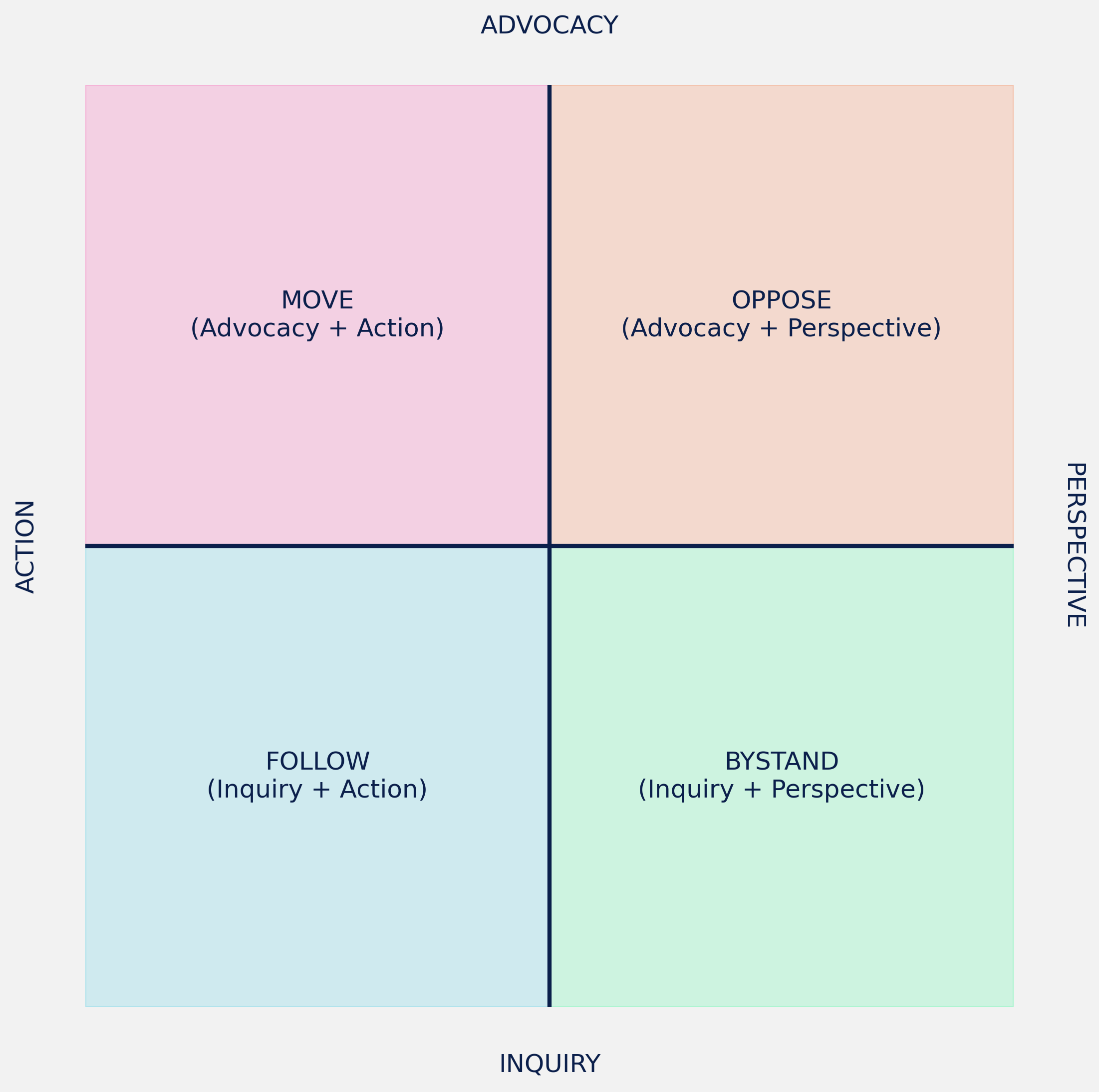
This diagram shows the four conversational actions identified in Kantor’s model arranged across two key dimensions: advocacy versus inquiry, and action versus perspective. Move and Oppose sit on the advocacy side, driving direction and correction. Follow and Bystand sit on the inquiry side, deepening understanding and widening perspective. Together they form a micro-map leaders can use to read conversations in real time. When one or more roles are missing or over-dominant, the group’s ability to navigate complexity is reduced. Balanced movement across all four roles supports adaptive thinking, inclusive participation and effective task progress.
Groups often privilege certain roles and marginalise others.
Movers get labelled decisive.
Opponents get branded as difficult.
Followers become invisible.
Bystanders are accused of overthinking. When only one or two roles dominate, conversations stall or spiral into unproductive loops.
The task stops moving forward because the conversational engine is missing parts and patterns of power, or individuals meeting their own (conscious or unconscious) agenda take over. These imbalances often reflect how authority, identity and boundaries are being managed in the wider system (Meyer & Boninelli, 2007; Miller, 1989).
An effective leader navigating complexity reads this imbalance and deliberately restores it.
They legitimise opposition as a contribution to quality when it advances the work.
They invite perspective from quieter observers so dominant voices do not narrow the field of thinking.
They slow habitual movers long enough for completion and reflection to occur.
This requires leaders to develop awareness of their own unconscious patterns and how these interact with organisational dynamics (Lawlor et al., 2023).
Leaders who can name and reflect on their anxieties and defences are less likely to act them out through controlling, rescuing or withdrawing behaviours (Lawlor et al., 2023; Meyer & Boninelli, 2007).
Inclusion as a Conversational Tool
This model links directly to the tension between advocacy and inquiry described by Argyris and Schön. Advocacy pushes ideas forward through Move and Oppose. Inquiry deepens understanding through Follow and Bystand.
Navigating complexity requires a dynamic balance between the two. Organisations that overvalue advocacy produce fast decisions with shallow learning. Organisations that overvalue inquiry generate rich reflection without decisive action. Dialogic leadership treats this balance as a core capability rather than a personality preference, and all four moves form part of a leader’s developmental repertoire.
This also shifts attention from what people do in conversation to how they do it.
Voicing is the discipline of speaking one’s genuine view and enabling others to do the same.
Listening is participation in another person’s meaning, not passive silence.
Respecting treats others as legitimate sense-makers even in disagreement.
Suspending involves holding one’s assumptions lightly enough for new possibilities to appear.
These practices map onto the four roles in a way that turns leadership into observable behaviour.
Voicing energises Move and Oppose with authenticity rather than dominance.
Listening strengthens Follow and Bystand as active contributions.
Respect transforms opposition from attack into collaborative correction.
Suspension expands the bystander perspective into a shared space for thinking together.
Effective leadership in complexity involves hosting these qualities simultaneously while still advancing the task. Systems-psychodynamic coaching and group relations work can deepen this capacity by helping leaders examine how they take up role, authorise themselves and others, and manage boundaries under pressure (Meyer & Boninelli, 2007).
Taking Up Role and Sharing Power
Taking up one’s role becomes central when navigating complex systems. Taking up role involves aligning the person, the formal role and the system’s expectations, rather than over-identifying with any one of these (Meyer & Boninelli, 2007; Miller, 1989).
Leaders require both formal authorisation from the organisation and psychological self-authorisation to exercise authority in complex environments. They hold clear role boundaries, what is mine, ours and theirs, while remaining permeable enough to stay connected to stakeholders.
Attending to leadership identity, shaped by biography, culture and organisational narratives, supports this conscious role-taking (Lawlor et al., 2023). Working explicitly with role in coaching: who am I here, for whom, and to do what increases a leader’s capacity to tolerate ambiguity and conflict, two constant features of complexity.
The implications extend beyond individual leaders to how power is shared. Distributed and shared leadership spreads influence and decision authority across levels rather than concentrating it at the top (Bolden, 2011; Harris, 2013). Meta-analytic evidence links shared leadership with higher team effectiveness, particularly in complex work (D’Innocenzo et al., 2014).
Shared leadership can take collective forms, where members share many leadership roles, or distributed forms, where different people hold different roles (Li et al., 2021). Teams showing more collective patterns often demonstrate stronger effectiveness through improved teamwork processes.
Dialogic leadership provides a conversational infrastructure for sharing power.
Participatory forums and communities of practice bring diverse perspectives into strategy and problem-solving. Role clarity becomes explicit: who holds which forms of authority for what decisions and how these interact.
Decentralised decision-making is combined with a coherent overarching purpose so local autonomy does not fragment the system (Bolden, 2011; Jiang et al., 2023).
Psychological safety allows less powerful members to challenge, dissent and initiate leadership without fear of retaliation (D’Innocenzo et al., 2014; Jiang et al., 2023).
Attention to power dynamics helps prevent informal domination from simply replicating hierarchy, reinforcing inclusive leadership practices that support adaptive performance (Walsh, 2024).
Grounding Dialogic Leadership Practices in Daily Work
Dialogic leadership becomes practical when leaders treat conversations as intentional sites for navigating complexity.
Before important meetings, they clarify the task and consider which conversational roles are likely to be needed to move it forward.
During the exchange, they notice which of the four moves are active and which are missing, and they intervene to restore balance. They name patterns carefully and descriptively, drawing attention to moments when advocacy is crowding out inquiry or when opposition is absent.
Leaders also reflect after conversations on how authority was exercised, how boundaries were managed and how power circulated. They explore how their own anxieties and assumptions influenced the interaction and what this reveals about the wider system.
Over time, this repeated attention builds a shared language for thinking about how the organisation navigates complexity together. That shared language strengthens both inclusion and performance, linking dialogic leadership practices directly to the organisation’s capacity to respond adaptively and advance its most important tasks.
References
Argyris, C., & Schön, D. A. (1978). Organizational learning: A theory of action perspective. Addison-Wesley.
Bolden, R. (2011). Distributed leadership in organizations: A review of theory and research. International Journal of Management Reviews, 13(3), 251–269.
D’Innocenzo, L., Mathieu, J. E., & Kukenberger, M. R. (2014). A meta-analysis of shared leadership and team effectiveness. Journal of Applied Psychology, 99(2), 181–198.
Harris, A. (2013). Distributed leadership: Friend or foe? Educational Management Administration & Leadership, 41(5), 545–554.
Isaacs, W. N. (1999). Dialogue and the art of thinking together. Currency/Doubleday.
Jiang, G., Lam, S. K., Moolenaar, N. M., Arens, A. K., & Borrego, M. (2023). Complexity leadership in action: A team science case study. Frontiers in Research Metrics and Analytics, 8, 1211554.
Kantor, D. (2012). Reading the room: Group dynamics for coaches and leaders. Jossey-Bass.
Lawlor, D., Sher, M., Aram, E., Obholzer, A., & Gosling, J. (2023). The systems psychodynamics view of leadership. In D. Lawlor & M. Sher (Eds.), Systems psychodynamics: Innovative approaches to change, whole systems, and organisational life (Vol. 2). Routledge.
Li, N., Lin, X., & Tost, L. P. (2021). An examination of shared leadership configurations and their effectiveness in teams. Journal of Organizational Behavior, 42(5), 631–652.
Meyer, R., & Boninelli, I. (2007). Leadership development from a systems psychodynamic stance. SA Journal of Human Resource Management, 5(1), 22–30.
Miller, E. J. (1989). The “Leicester” model: Experiential study of group and organizational processes. In D. E. Klein & E. H. Gabelnick (Eds.), The psychodynamics of organizations (pp. 239–259). University Press of America.
Obholzer, A., & Roberts, V. Z. (Eds.). (1994). The unconscious at work: Individual and organizational stress in the human services. Routledge.
Walsh, S. (2024). Inclusive Leadership Navigating Organisational Complexity. ELIS Institute.
