
Inclusive Leadership
Navigating Organsiational Complexity
Inclusive Leadership: Navigating Organisational Complexity is a transformative guide that reshapes how we understand professional development, organisational behaviour, leadership, diversity, and inclusion.
Through real-life narratives, evidence-based insights, and reflective exercises, Sile Walsh redefines inclusion as a core human need essential for individuals and organisations to perform and thrive.
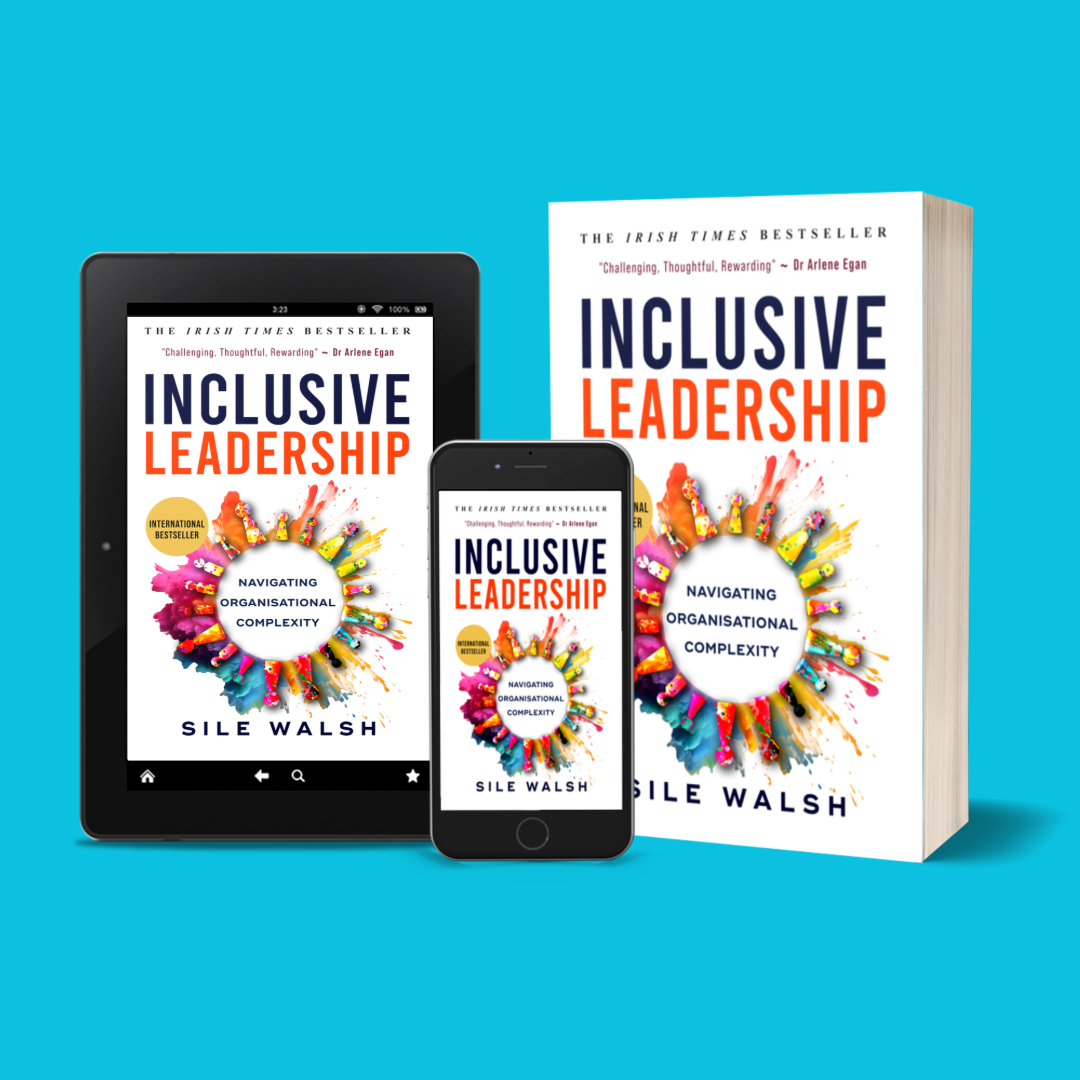
Since its publication in May 2024, Inclusive Leadership: Navigating Organisational Complexity has received widespread recognition and acclaim:
Winner: Goodie Business Book Awards 2024 – Leadership DEI
Silver Winner: Nautilus Book Awards 2025
Bestseller: Irish Times, May 2024
Bestseller: Sunday Independent, May 2024
International Bestseller: Amazon, 2024 & 2025
Longlisted: CAP Awards 2024
The Benefits of reading Inclusive Leadership Navigating Organisational Complexity include:
Discover the “13 Inclusive Leadership Practices and Principles” to navigate organisational complexity.
Uncover the strategies to improve performance and organisational excellence through embracing relational and psychological approaches to inclusive leadership.
Gain the knowledge to navigate the intricate challenges and opportunities facing the modern workplace regarding diversity and inclusion conversations.
Learn to harness inclusive leadership tools and frameworks to support organisational purpose with practical applications from industry insights.
Embed inclusive practices into organisational culture at every opportunity to create sustainable results.
What if inclusive leadership wasn’t just a “nice to have” but the key to organisational success?
If you're tired of inclusion being reduced to a tick-box exercise, this book offers a new path, one rooted in performance, people, and purpose.
Inclusive Leadership: Navigating Organisational Complexity will help you:
Shift from compliance-driven inclusion to performance-driven leadership
Discover the "13 Inclusive Leadership Practices and Principles" for navigating complexity
Embed inclusion into your daily leadership practice and team culture
Move from fear to freedom and from surviving to thriving
Foster psychological safety, self-awareness, and high-performing teams
What can you expect from Inclusive Leadership: Navigating Organisational Complexity?
Practical Guidance: Ways to lead inclusively, regardless of your job title
Focus on Being: Embody inclusion rather than just doing diversity tasks
Thoughtful Authenticity: Lead with honesty aligned with purpose
Human Connection: Foster self-awareness and relational intelligence
Root-Cause Approach: Address exclusion at its source for real change
Empowering Tools: Combine research with practical, compassionate strategies
Whether you're a senior leader, HR professional, organisational consultant, or people manager, this book offers you a strategic companion for driving meaningful, sustainable change.
“It’s not about doing more. It’s about doing what matters better.”
FAQ
What is inclusive leadership?
Inclusive leadership refers to how leaders create environments where different perspectives, experiences, and needs are actively included in decision-making, performance, and everyday work. In Inclusive Leadership: Navigating Organisational Complexity (Walsh, 2024), it is positioned as a multidirectional, context-sensitive leadership approach shaped by the interaction between individual, relational, organisational, and external influences. It is not just a set of behaviours, but a way of leading that connects people, performance, and organisational outcomes in real organisational conditions, not idealised ones.
Why is inclusive leadership important in organisations?
Inclusive leadership matters because it directly influences decision quality, team performance, engagement, and retention. When people’s perspectives are included, organisations gain access to better thinking, stronger collaboration, and more effective outcomes in practice. The book highlights that inclusion is not an additional initiative, but a core leadership requirement for navigating complexity, competing demands, and diverse stakeholder needs.
Why is inclusive leadership important for performance?
Inclusive leadership supports performance by improving how decisions are made, how teams work together, and how challenges are approached. It reduces blind spots, increases accountability, and strengthens execution in complex environments.From the perspective of the Include-Performance Framework™, inclusion is directly linked to performance through how effectively leaders integrate different perspectives into action, rather than leaving them as input without impact.
What are inclusive leadership practices?
Inclusive leadership practices include how leaders communicate, make decisions, share power, respond to difference, and create conditions for contribution. These practices show up in everyday interactions, not just in formal strategies or initiatives. The book emphasises that these practices operate across multiple levels, including individual behaviour, team dynamics, organisational systems, and external pressures, rather than being isolated to the leader alone.
What does inclusive leadership look like in practice?
In practice, inclusive leadership can be seen in how meetings are run, how input is invited and used, how feedback is handled, and how decisions are explained. It is visible in behaviours, not just intentions. It also becomes visible in moments of tension, trade-offs, and competing priorities, where leaders are navigating real constraints while still working to include different needs and perspectives in meaningful ways.
Is inclusive leadership a theory or a practice?
Inclusive leadership can be understood as both a theory and a practice. It draws on research and frameworks, but its value is realised through how it is enacted in real organisational contexts. In the book, it is positioned as a developing leadership theory grounded in lived organisational experience, where its relevance is tested through application rather than abstract understanding alone.
Who developed inclusive leadership theory?
Inclusive leadership has evolved through contributions from multiple researchers and practitioners. Rather than a single origin, it reflects a growing body of work focused on leadership, inclusion, and organisational performance. The book contributes to this field by advancing inclusive leadership as a multidirectional and contextually embedded theory, informed by qualitative research in for-profit organisations in Ireland and the UK.
What are the principles of inclusive leadership?
Different models outline varying principles, but most focus on awareness, openness, fairness, accountability, and the ability to engage effectively with difference. In the book, these are explored through how leaders navigate complexity in practice, with a focus on balancing inclusion with performance, decision-making, and organisational realities rather than treating principles as standalone ideals.
How does inclusive leadership drive cultural change?
Inclusive leadership influences culture through consistent behaviours, decision-making patterns, and the signals leaders send about what is valued, accepted, and expected within the organisation. The book highlights that culture shifts when inclusion is embedded into everyday leadership practice, systems, and decisions, rather than positioned as a separate initiative or value statement.
What is the difference between inclusive leadership and effective leadership?
Inclusive leadership can be understood as a way of strengthening effective leadership. It brings attention to how inclusion influences performance, relationships, and organisational outcomes. The book argues that effective leadership and inclusive leadership are not separate concepts, but that effectiveness is limited when inclusion is not actively considered in how leadership is enacted.