
The Progress Triangle
Flipping the Drama Triangle at Work for More Effective Relating
What this article covers:
What the Drama Triangle looks like in workplace settings
Why it impacts leadership, performance, and team dynamics
How the Progress Triangle™ reframes these patterns for organisations
Practical ways to shift how you lead and relate at work
From Drama to Progress: Rethinking Leadership Dynamics in the Workplace
In many organisations, challenges are rarely just about strategy, capability, or performance. They are often about how people relate to each other under pressure.
Conversations repeat.
Tensions build.
Decisions stall or escalate too quickly.
And while these situations are often described as “difficult people” or “poor communication,” they can often be understood more clearly through patterns of interaction. One of the most well-known frameworks for understanding these patterns is the Karpman Drama Triangle (Karpman, 1968). But understanding the problem is only part of the work. The real question for leaders is: what does a more effective alternative look like in practice?
Over time, a number of alternative models have been developed to respond to this, including the Empowerment Triangle (Choy, 1990), which reframes the roles into more resourceful and constructive positions. Building on this evolution, the Progress Triangle™ is designed specifically for workplace settings, where performance, accountability, and relational dynamics are continuously interacting.
The Drama Triangle in Organisational Life
The Drama Triangle describes three roles that people can move between in moments of tension:
The Persecutor – critical, controlling, or forceful
The Rescuer – over-helpful, intervening, or taking responsibility for others
The Victim – disempowered, overwhelmed, or deferring responsibility
These roles are not fixed identities. They are patterns of behaviour that can emerge in response to pressure, uncertainty, or relational dynamics.
In organisations, this can look like:
A manager pushing for compliance without dialogue
A colleague stepping in to “fix” situations that are not theirs to own
A team member disengaging or deferring decisions
While each role can feel justified in the moment, the overall effect is often the same:
Reduced clarity
Diffused accountability
Lower trust
Slower or reactive decision-making
Leaders can find themselves moving between all three roles, often without realising it. In workplace environments, these patterns often become embedded in ways of working, influencing how decisions are made, how responsibility is shared, and how performance is experienced across teams (Walsh, 2024).
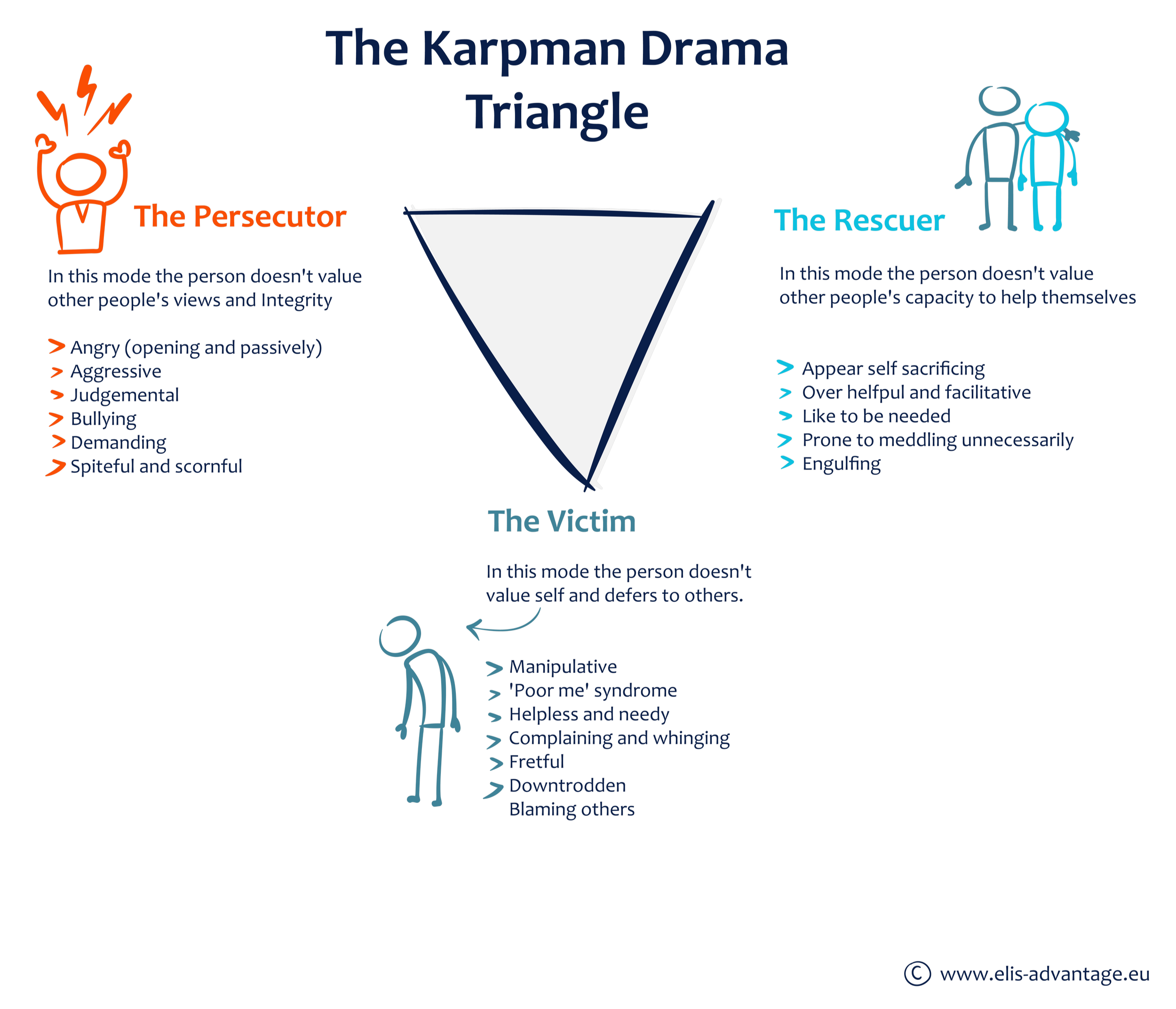
A visual diagram titled “The Karpman Drama Triangle” showing an inverted triangle at the centre, representing three relational roles that people move between under pressure. On the left, “The Persecutor” is illustrated with an animated figure expressing anger, accompanied by behaviours such as aggressive, judgemental, bullying, demanding, and spiteful. The description notes that in this mode, the person does not value other people’s views and integrity. On the right, “The Rescuer” is shown supporting others, with behaviours including appearing self-sacrificing, over-helpful, liking to be needed, meddling unnecessarily, and becoming engulfed. The description highlights that this role does not value others’ capacity to help themselves. At the bottom of the triangle, “The Victim” is illustrated as a slumped figure, with behaviours such as feeling helpless, complaining, manipulative, “poor me” thinking, and blaming others. The description explains that in this mode, the person does not value themselves and defers to others. The overall image represents reactive and unproductive patterns of interaction that can emerge in workplace relationships and leadership dynamics.
In workplace settings, the Drama Triangle often shows up in subtle and normalised ways rather than extreme behaviours.
The Persecutor may appear as a person who pushes for outcomes without discussion, becomes overly directive under pressure, or critiques without creating space for response.
The Rescuer may take on responsibility that sits with others, stepping in to fix issues, over-supporting, or shielding people from accountability in the name of being helpful.
The Victim may show up as disengagement, deferring decisions, repeated expressions of being overwhelmed, or a reluctance to take ownership in uncertain situations.
These roles can move quickly between individuals and teams, often within the same conversation, creating patterns where responsibility becomes unclear and progress slows. The main rule is, if 1 position on the drama traingle is present its likely we are all on teh drama triangle.
The Karpman Drama Triangle – Detailed Examples of Workplace Norms
The Persecutor (Workplace Expression)
In this mode, the person may prioritise control, outcomes, or being right over collaboration or input from others.
Directs rather than discusses
Becomes overly critical under pressure
Focuses on what’s wrong without exploring solutions
Pushes for immediate action without context
Dismisses or overlooks others’ perspectives
Uses authority to drive compliance
The Rescuer (Workplace Expression)
In this mode, the person may take on responsibility that sits with others, often with positive intent but limiting ownership.
Steps in to solve problems for others
Offers solutions before fully understanding the issue
Takes on additional work to “help” the team
Avoids difficult conversations by over-supporting
Finds it hard to step back or delegate
Feels responsible for others’ outcomes or wellbeing
The Victim (Workplace Expression)
In this mode, the person may feel or present as unable to act, often deferring responsibility or decision-making.
Waits for direction rather than taking initiative
Expresses being overwhelmed without identifying next steps
Defers decisions to others
Repeats challenges without moving towards resolution
Focuses on constraints without exploring options
Disengages or withdraws from responsibility
Why This Matters for Leadership and Performance
These patterns are not just interpersonal. They shape how work gets done. When teams operate within the Drama Triangle:
Accountability becomes blurred
Ownership is avoided or over-assumed
Conversations become emotionally charged or avoided altogether
Over time, this affects performance, decision quality, and organisational culture. What is often missing is not effort or intent, but a different way of structuring interaction. As outlined in Inclusive Leadership: Navigating Organisational Complexity, leadership effectiveness is shaped not only by individual behaviour but by the relational and systemic dynamics that influence how people engage, decide, and perform (Walsh, 2024).
From Drama to Progress: Introducing the Progress Triangle™
The Progress Triangle™ offers an alternative set of roles that shift the focus from reaction to intention, and from dependency to agency. Rather than removing tension, it reframes how people engage with it. While models such as the Empowerment Triangle focus on personal growth and psychological reframing, the Progress Triangle™ is specifically designed for organisational and leadership contexts, where clarity, accountability, and performance need to be actively maintained alongside supportive relationships.
The Progress Triangle™ offers an alternative set of roles that shift the focus from reaction to intention, and from dependency to agency. Rather than removing tension, it reframes how people engage with it. While models such as the Empowerment Triangle focus on personal growth and psychological reframing, the Progress Triangle™ is specifically designed for organisational and leadership contexts, where clarity, accountability, and performance need to be actively maintained alongside supportive relationships.
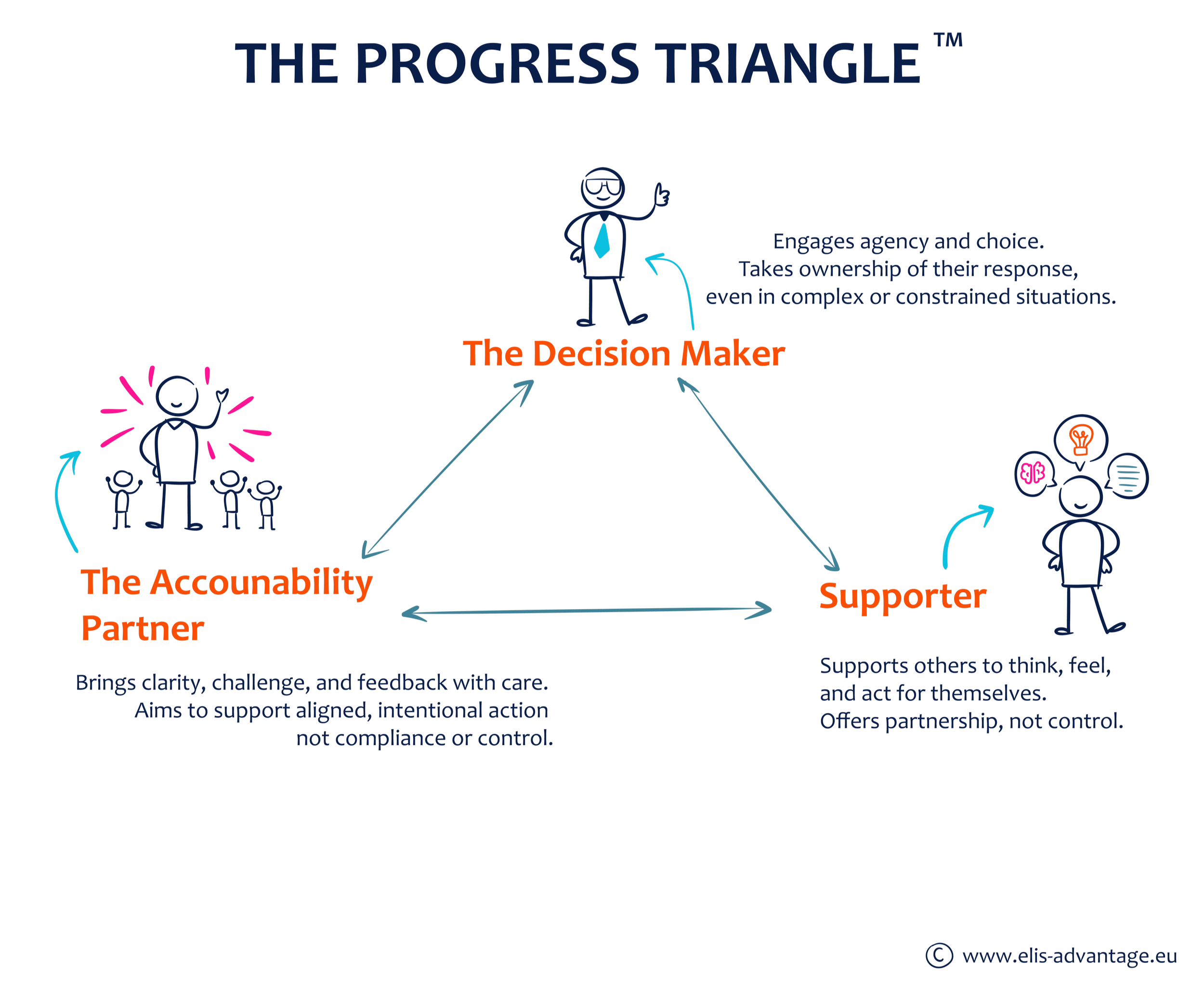
A visual diagram titled “The Progress Triangle™” showing an upright triangle that represents three intentional leadership roles designed to support effective workplace interactions and performance. At the top of the triangle is “The Decision Maker,” illustrated as a confident figure. The description highlights engaging agency and choice, and taking ownership of responses, even in complex or constrained situations. On the right, “Supporter” is shown as a figure surrounded by symbols of thinking and ideas. The description explains that this role supports others to think, feel, and act for themselves, offering partnership rather than control. On the left, “The Accountability Partner” is illustrated engaging with others, representing clarity, challenge, and feedback. The description notes that this role supports aligned, intentional action, rather than compliance or control. Arrows between the three roles indicate movement and flexibility, emphasising that effective leadership involves shifting between these positions depending on the situation. The overall image represents a shift from reactive patterns to intentional, accountable, and supportive ways of working within organisational settings.
The three roles of the progress triangle are:
The Decision Maker: Engages agency and choice. Takes ownership of their response, even in complex or constrained situations. In practice, this can look like:
Making decisions with available information rather than waiting for certainty
Taking responsibility for outcomes rather than deferring upwards or outwards
Acknowledging constraints while still identifying options
The Supporter: Supports others to think, feel, and act for themselves. Offers partnership, not control. In practice:
Asking questions rather than providing immediate solutions
Creating space for others to contribute and decide
Resisting the pull to over-help or take over
The Accountability Partner: Brings clarity, challenge, and feedback with care. Supports aligned, intentional action rather than compliance. In practice:
Naming what is not being addressed
Holding expectations while maintaining respect
Focusing on shared outcomes rather than individual fault
The Shift Leaders Are Making
The movement from the Drama Triangle to the Progress Triangle is not about eliminating difficult moments. It is about changing how those moments are navigated. For leaders, this often involves:
Moving from control to clarity
Moving from rescuing to (positive) enabling
Moving from reacting to choosing
This shift is subtle, but it changes the dynamic of conversations and decisions. For example:
Instead of solving a problem for someone, a leader might ask: “What options are you considering?”
Instead of pushing for compliance, they might say: “Here’s what needs to be achieved. Let’s work through how that can happen.”
Instead of avoiding challenge, they might name it directly, with care and intention
These are small shifts, but they change where responsibility sits. In workplace settings, these shifts support more effective relating by maintaining both performance expectations and human connection, rather than defaulting to control, avoidance, or over-accommodation (Walsh, 2024).
What This Means in Practice
Leaders rarely operate in one role consistently. What matters is the ability to notice patterns and respond intentionally.
You might begin by asking:
Where do I tend to step in too quickly?
Where do I hold back from necessary challenge?
Where do I defer decisions that could sit with me?
And then consider:
What would it look like to take a Decision Maker stance here?
How could I act as a Supporter without taking over?
Where could I bring Accountability in a way that supports progress?
These reflections support a move from reactive patterns to more intentional leadership behaviours that align with both individual and organisational needs.
A More Intentional Leadership Practice
The Progress Triangle™ is not about replacing one model with another. It is about offering a practical way to move from patterns that limit progress to patterns that support it. It provides a workplace-specific lens on how leaders can engage with complexity, balancing agency, support, and accountability in real time. In complex organisational environments, leadership is not only about what decisions are made. It is about how people engage with each other in making them. And often, that is where the real shift happens.
Sign up to our leadership letters in the footer to recieve more insights like this and develop your leadership skills.
References
Karpman, S. (1968). Fairy tales and script drama analysis. Transactional Analysis Bulletin, 7(26), 39–43.
Choy, A. (1990). The winner’s triangle. Transactional Analysis Journal, 20(1), 40–46.
Walsh, S. (2024). Inclusive leadership: Navigating organisational complexity. ELIS Institute.
