
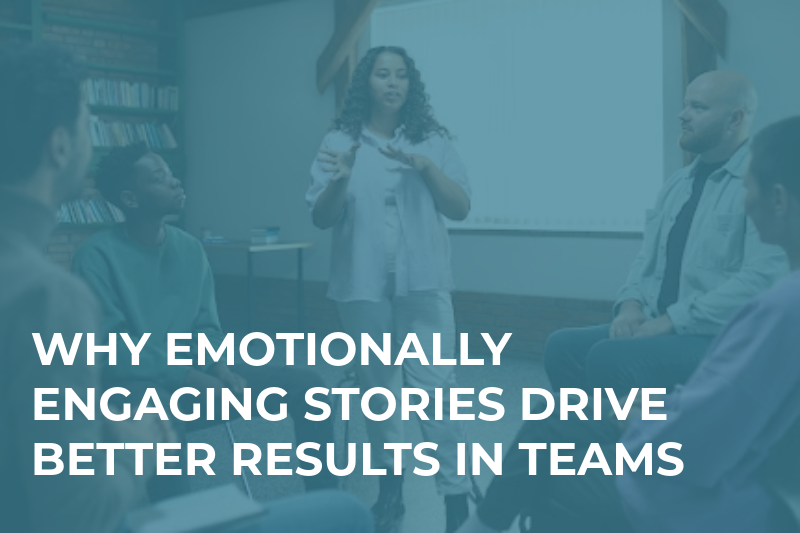
Why Emotionally Engaging Stories Drive Better Results In Teams
Research by Zak (2015) provides compelling evidence that emotionally rich stories activate the brain in powerful ways. In controlled experiments, participants who watched emotionally engaging narratives showed increased levels of oxytocin, a neurochemical associated with trust, empathy, and connection. This oxytocin release was directly linked to their willingness to donate money, support a cause, or take meaningful action. The takeaway: stories that generate emotional resonance don't just entertain, they move people, literally and biologically.
Stories engage multiple brain regions, helping us simulate experiences, form emotional connections, and internalise values. Zak argues that the structure of an effective story, beginning with attention-grabbing tension and ending with resolution, mirrors the neurobiological process of engagement and empathy. This process explains why storytelling can shift beliefs, foster connection, and drive aligned behaviour.
Leadership: Building Trust and Influencing Action
In leadership, influence is often assumed to come from logic and authority. However, Zak’s findings suggest that trust and connection are more powerfully cultivated through emotionally resonant stories. Leaders who share honest, value-driven narratives are more likely to build rapport, foster motivation, and create environments where people feel seen and heard.
Stories also help bridge the gap between strategy and execution. When a leader shares a narrative about why a change is happening, what it means, and how people are involved, it anchors the change in purpose, making it easier for others to align and act.
Inclusion: Creating Psychological Safety and Shared Meaning
Storytelling plays a critical role in advancing inclusion. When leaders invite or share stories from different lived experiences, they make space for underrepresented voices to be heard and validated. This isn’t just performative, it fosters empathy, challenges unconscious bias, and builds psychological safety.
Inclusive storytelling also helps people feel a genuine sense of belonging. Rather than being asked to fit into a dominant narrative, individuals are invited to co-create the organisational story. This creates cultural cohesion without erasing differences, a hallmark of inclusive leadership.
Performance: Motivating Through Connection
Zak’s research shows that when oxytocin is released, people are more likely to behave prosocially, supporting others, engaging meaningfully, and contributing to a collective goal. In performance terms, storytelling is not a ‘soft’ skill, it’s a strategic capability. Leaders who connect people to purpose through narrative can boost engagement, alignment, and discretionary effort.
Teams that share stories about success, failure, learning, and resilience develop stronger relational bonds, better conflict navigation, and greater adaptability.
Practical Strategies for Leaders
Use real stories: Share experiences that connect emotionally, not just intellectually. Focus on challenges overcome, lessons learned, or values in action.
Create space for others' stories: In meetings, reviews, or onboarding, invite people to share meaningful experiences that shaped their views or decisions.
Frame change through narrative: During transitions, communicate through story, what was, what is changing, and what the vision is going forward.
Use stories to model inclusion: Highlight examples of inclusive behaviour, listening across differences, or learning from mistakes.
Make storytelling a habit: Incorporate story-sharing into 1:1s, team updates, or leadership development sessions.
The Power of Story at Work
In a complex and often fragmented workplace, storytelling offers a simple but powerful tool: it connects people through shared emotion, meaning, and trust. Zak’s neuroscience-based evidence reinforces what many effective leaders know intuitively, people follow those who make them feel something, not just those who know something. By embedding story into everyday leadership practice, we can foster inclusion, build stronger teams, and improve performance at every level.
Reference
Zak, P. J. (2015). Why inspiring stories make us react: The neuroscience of narrative. PLOS ONE, 10(10), e0141420. https://doi.org/10.1371/journal.pone.0141420
